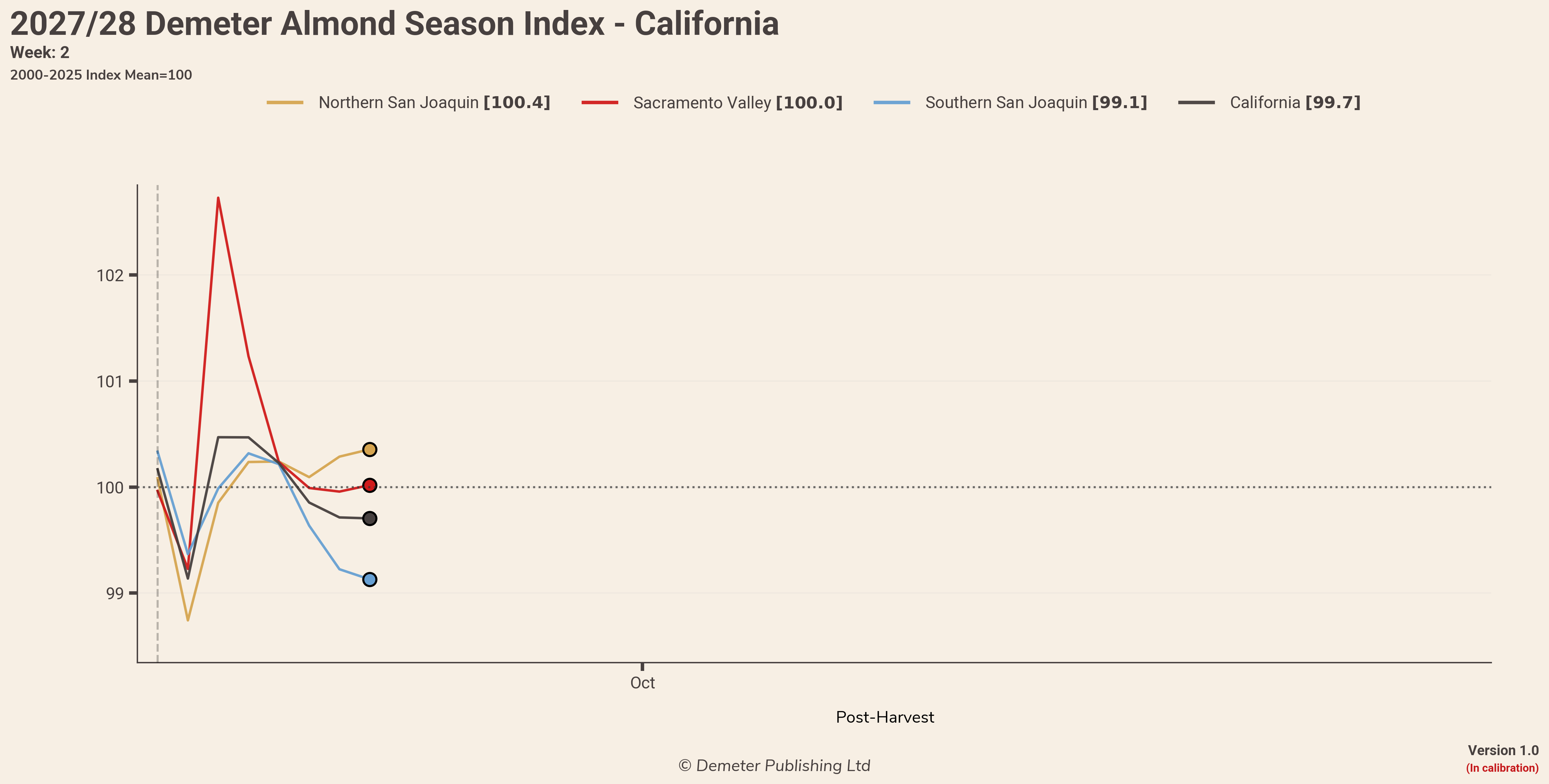
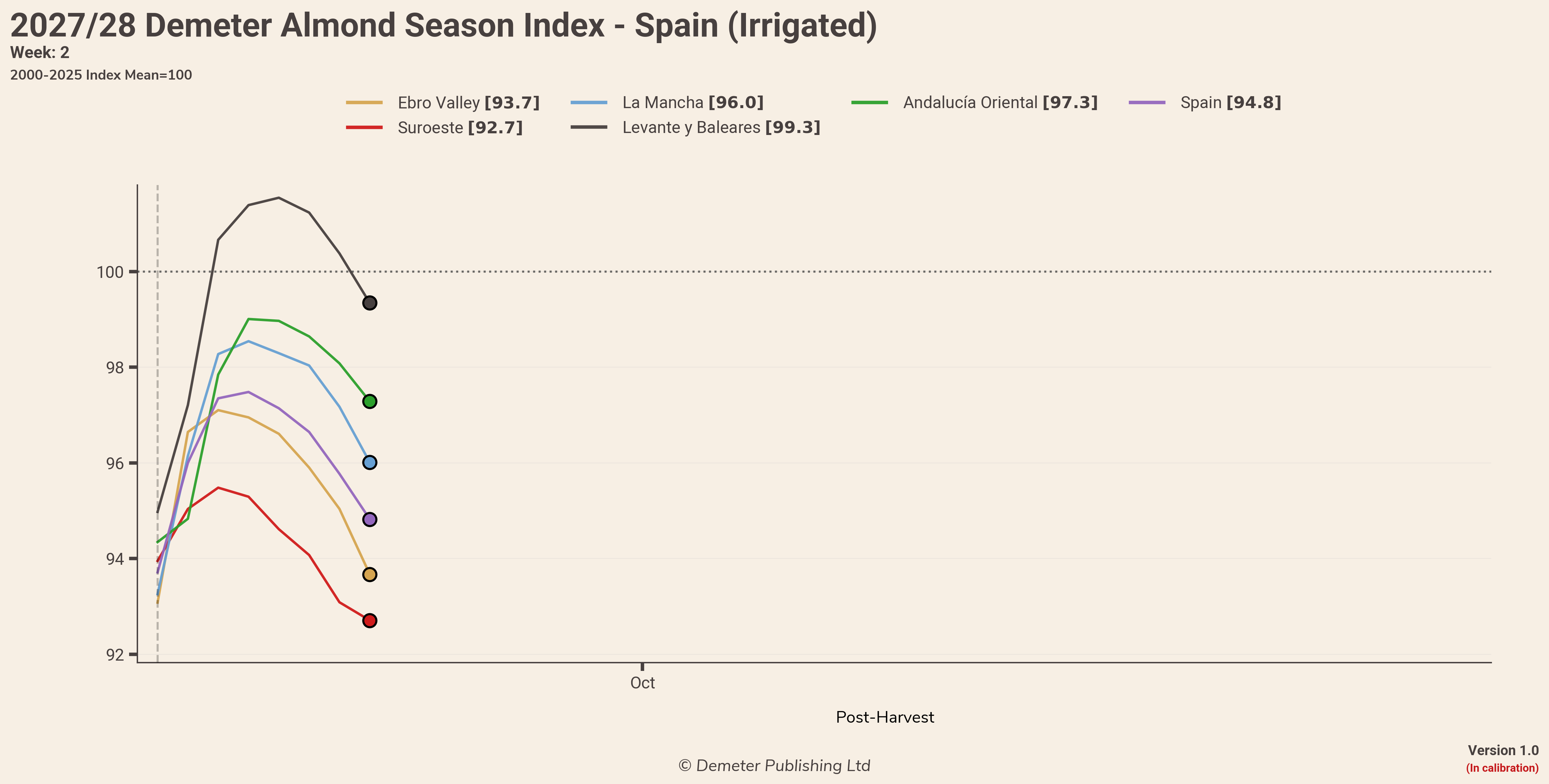
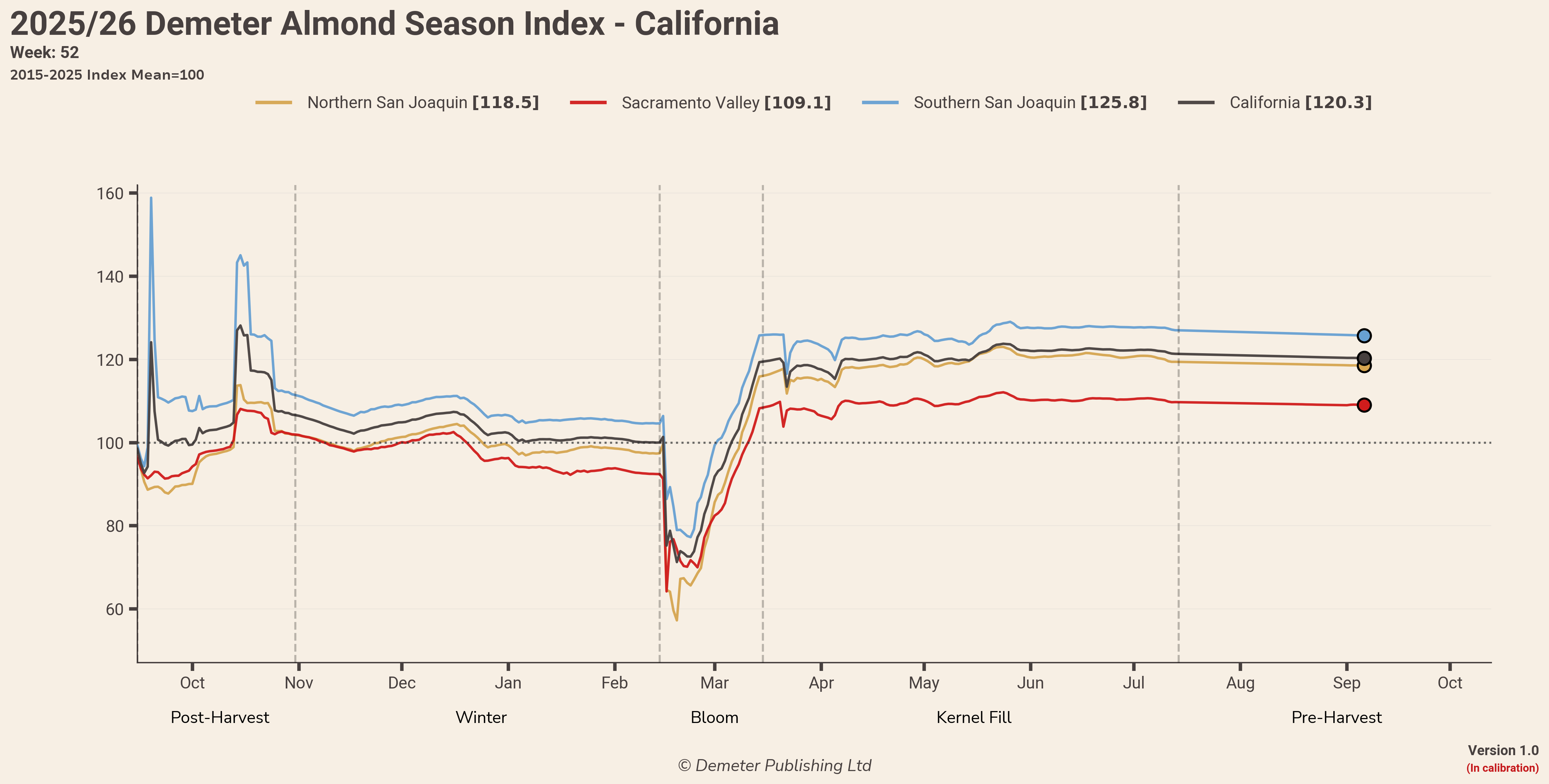
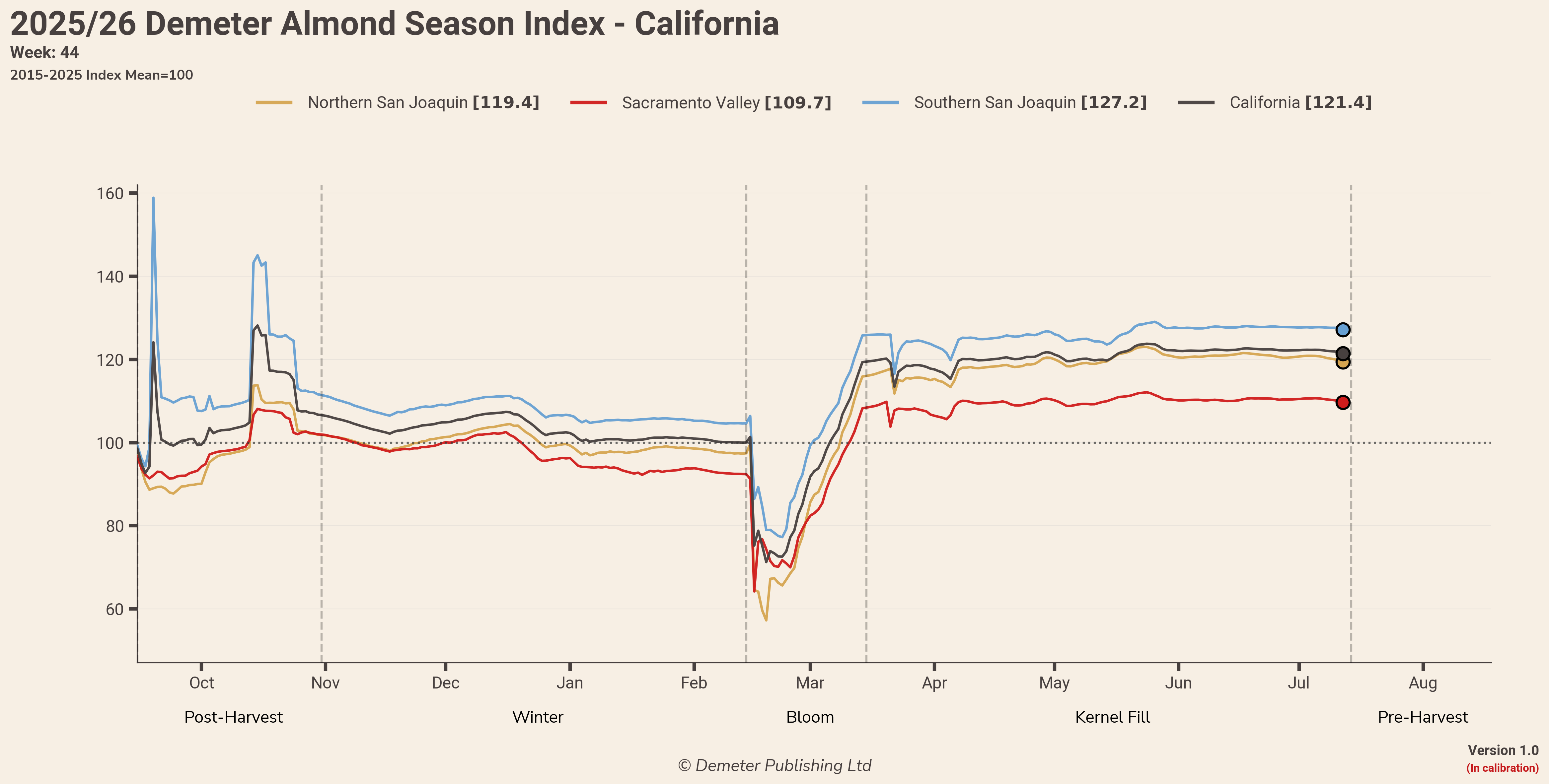
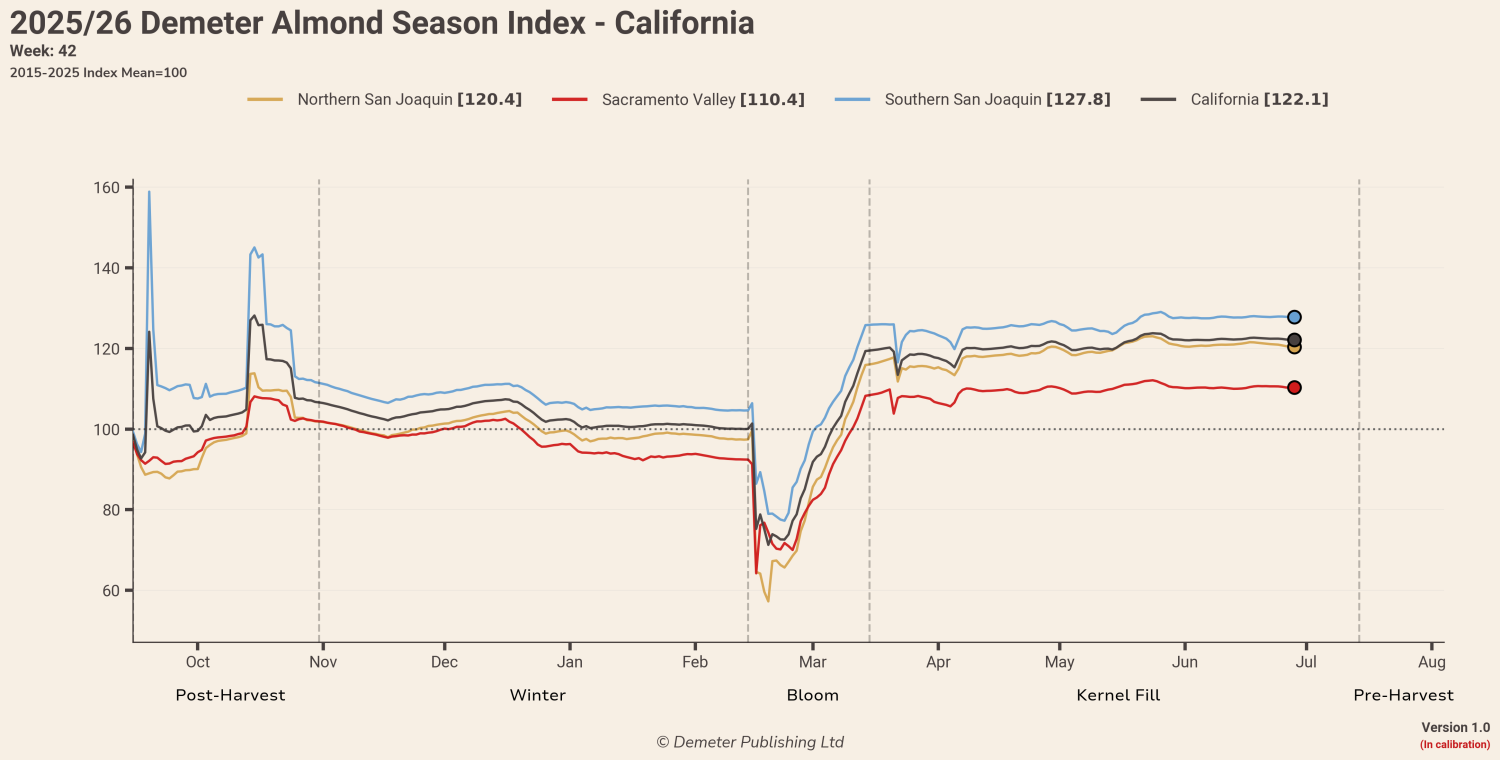
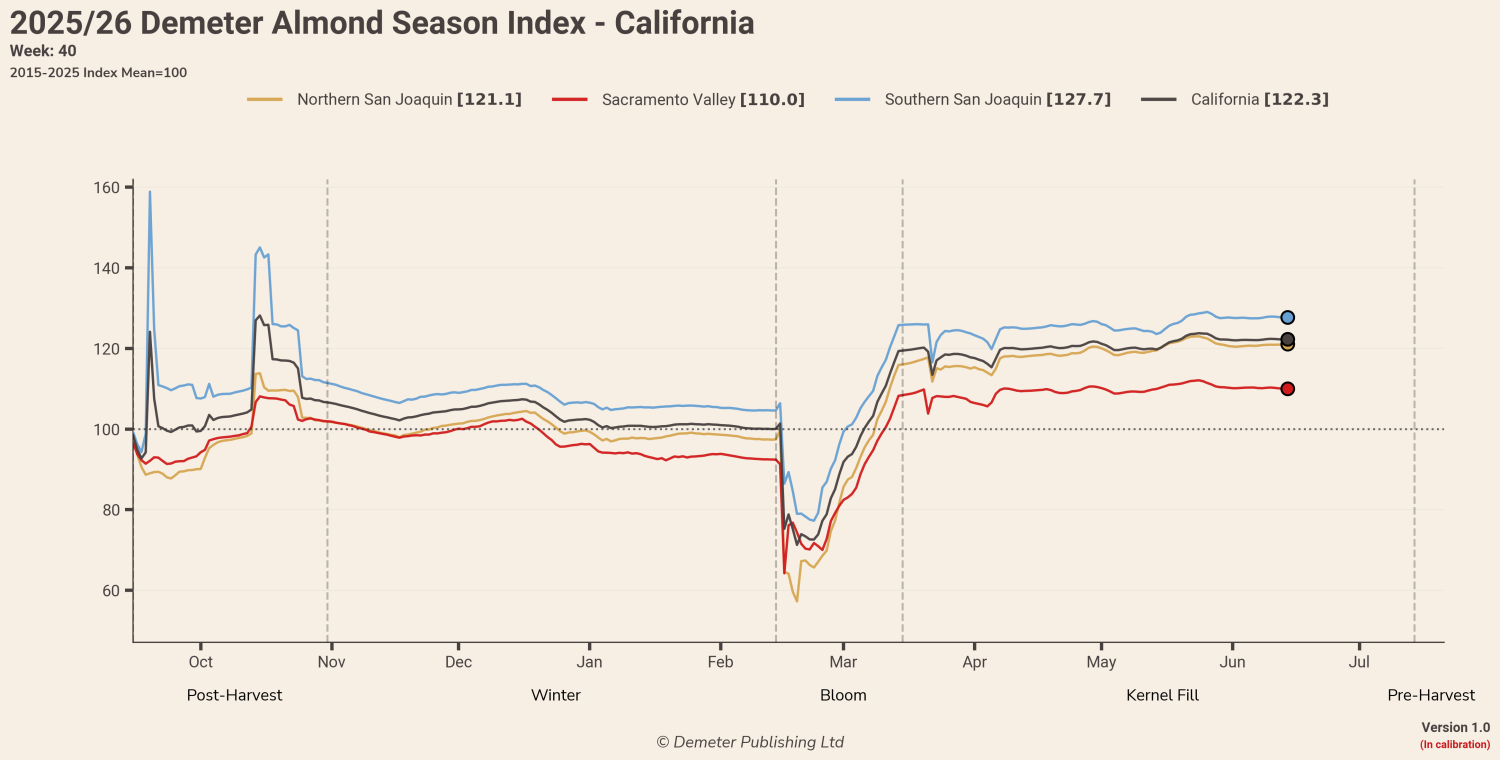
Demeter Almond Season Index Update - Week 30
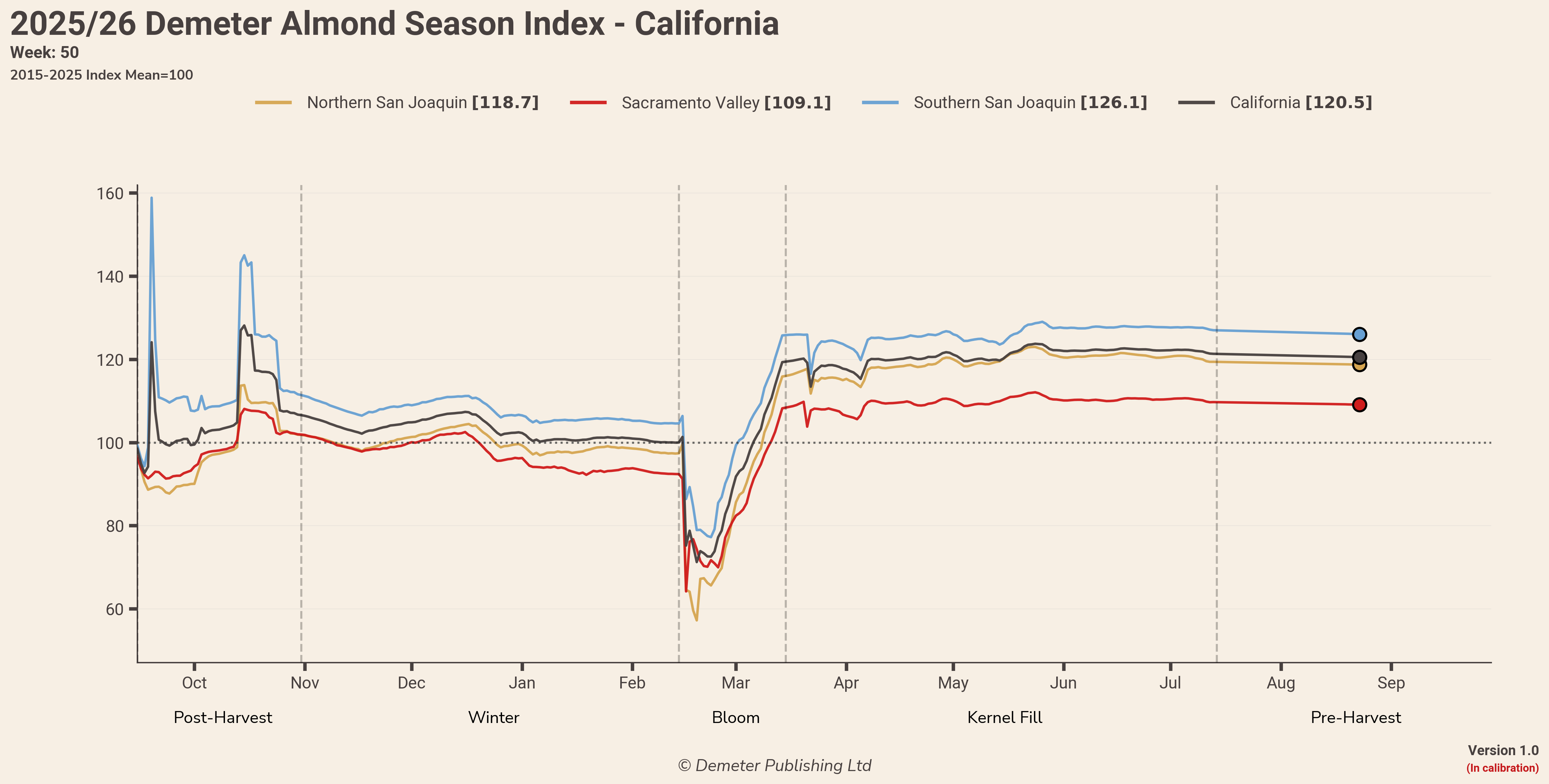
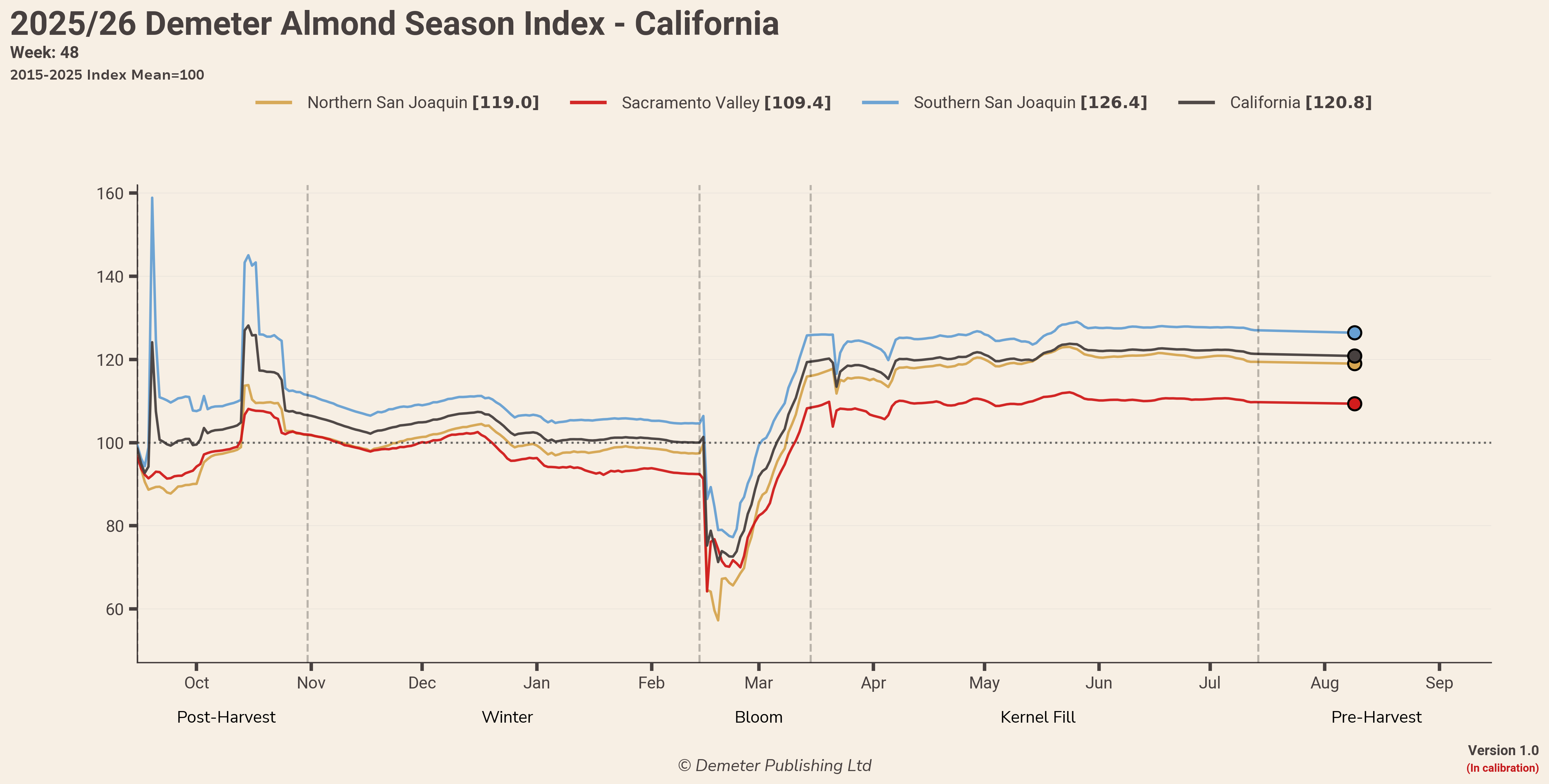
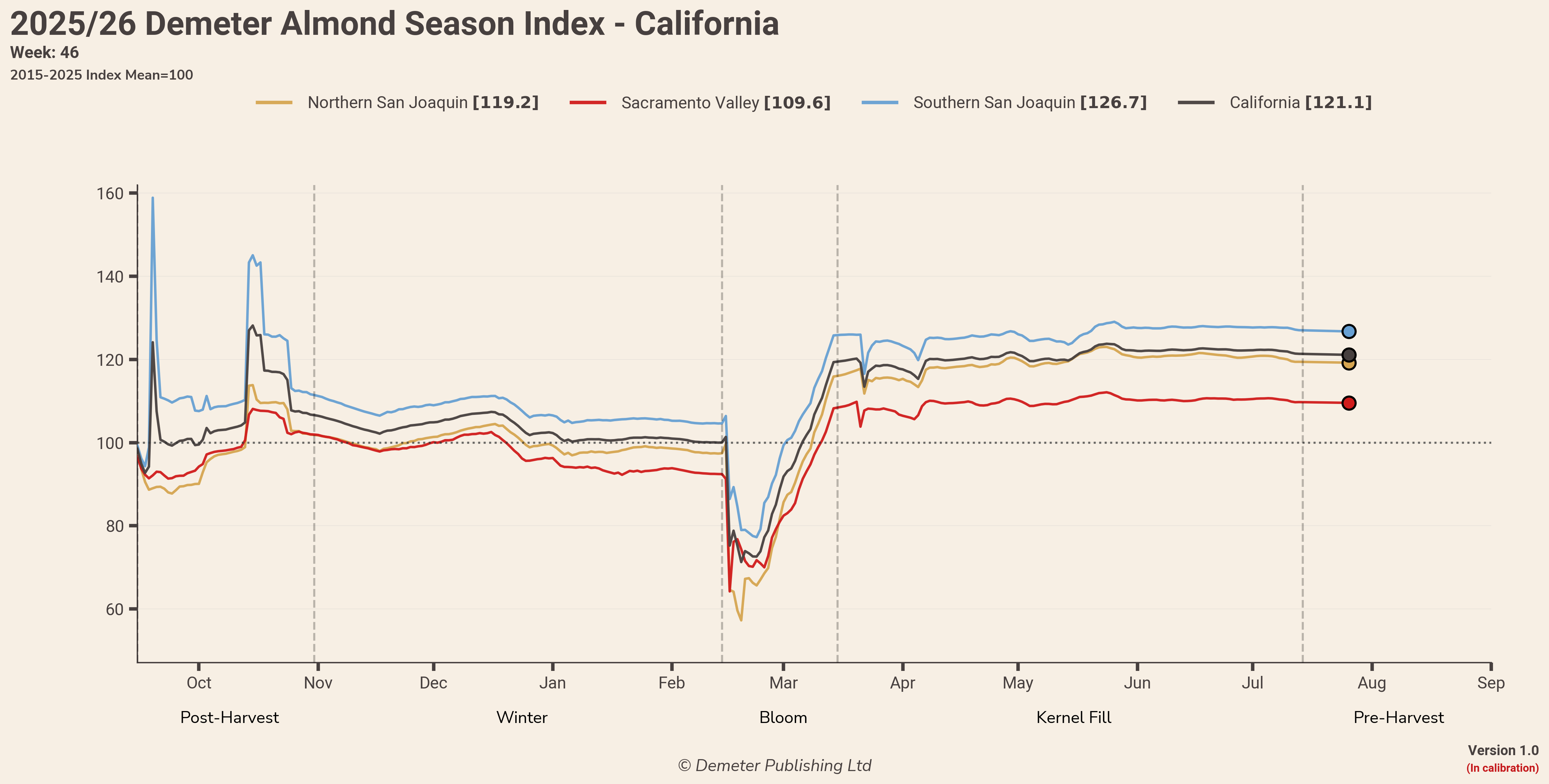
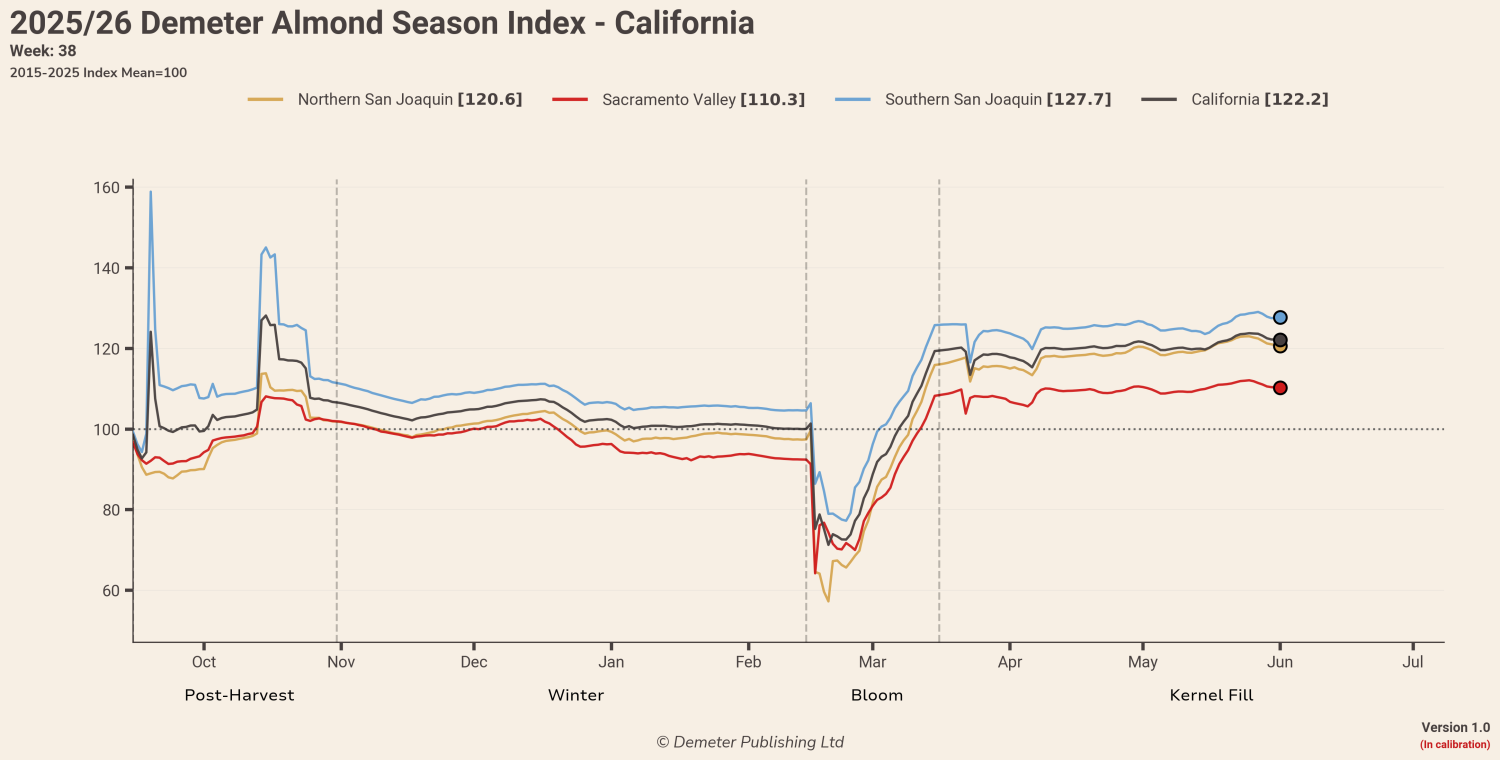
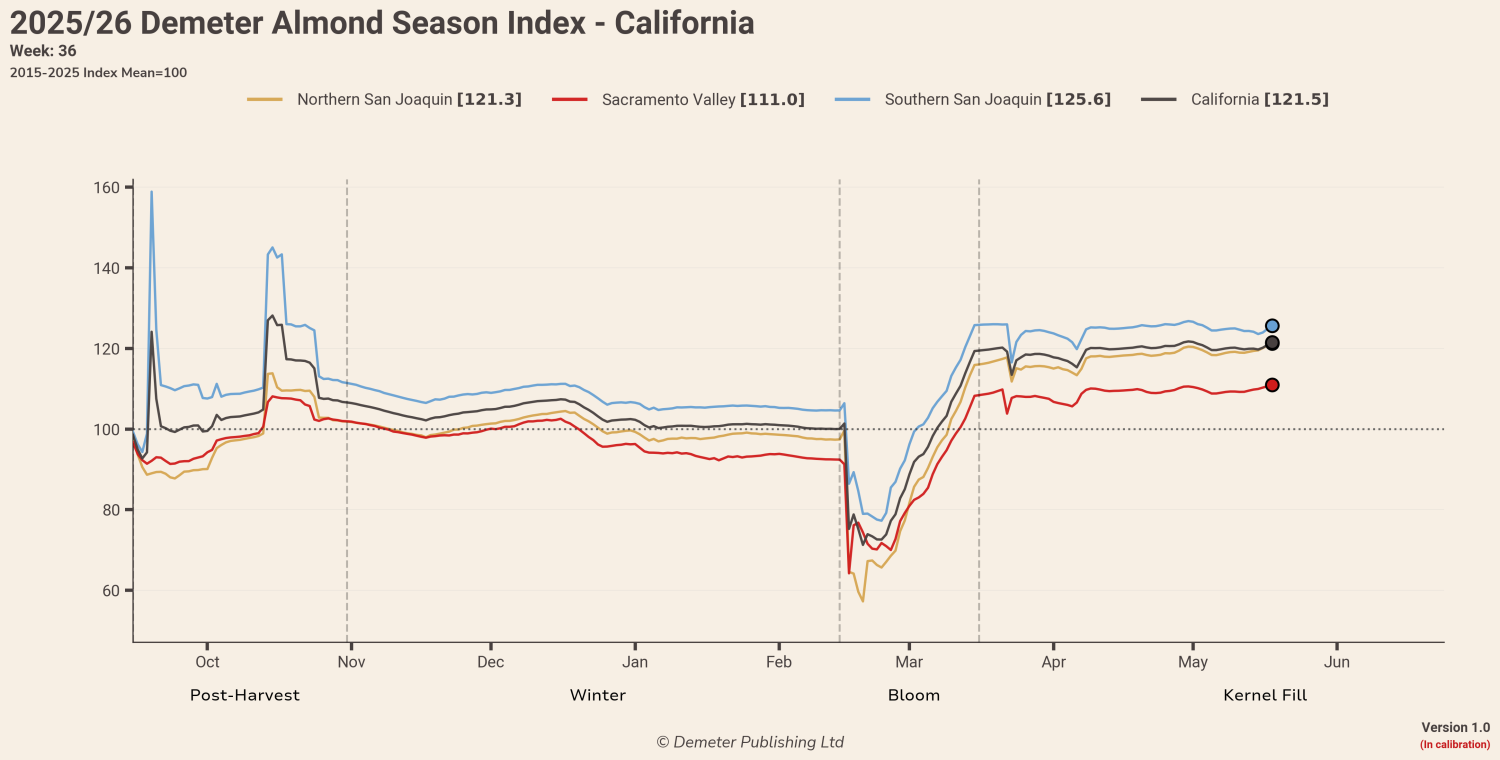
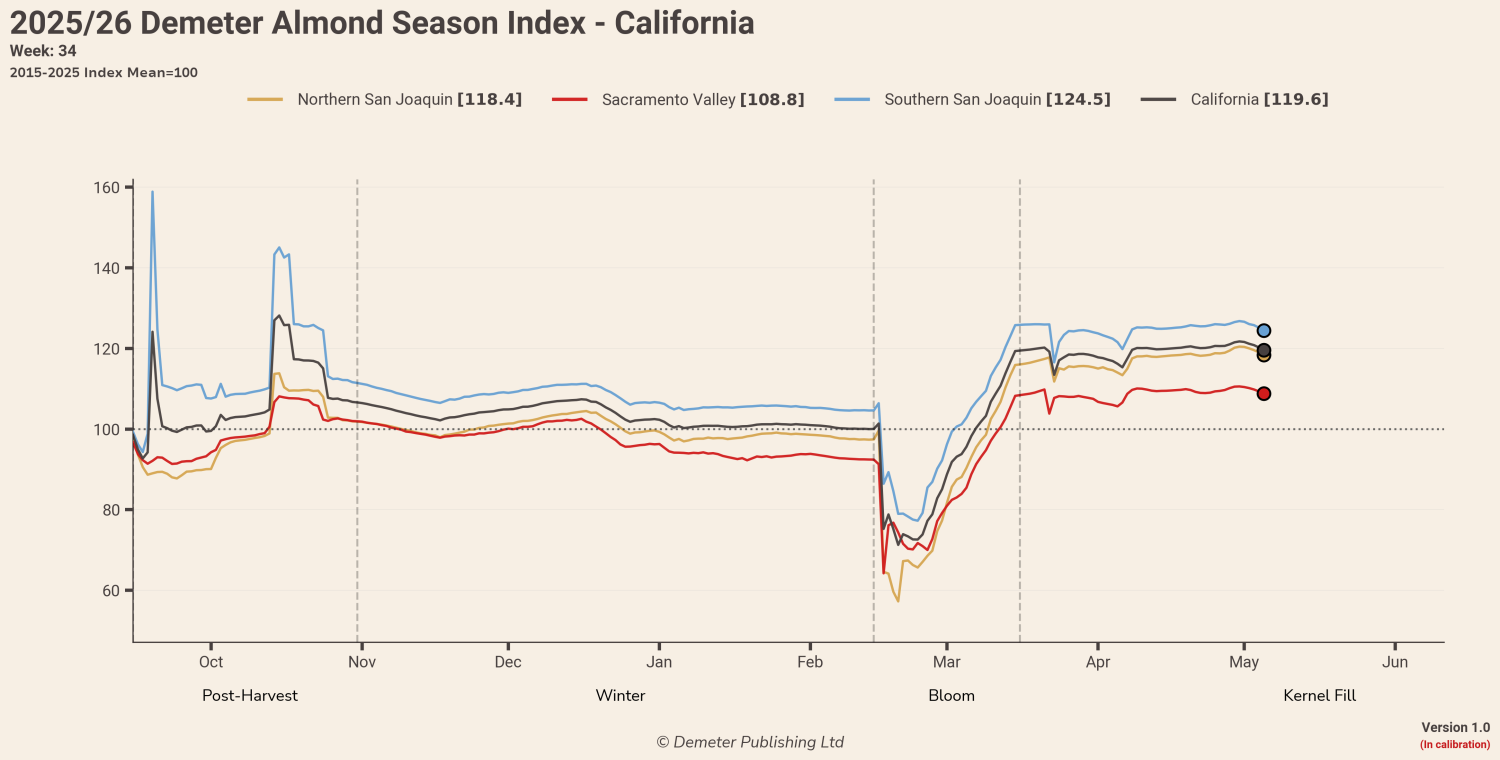
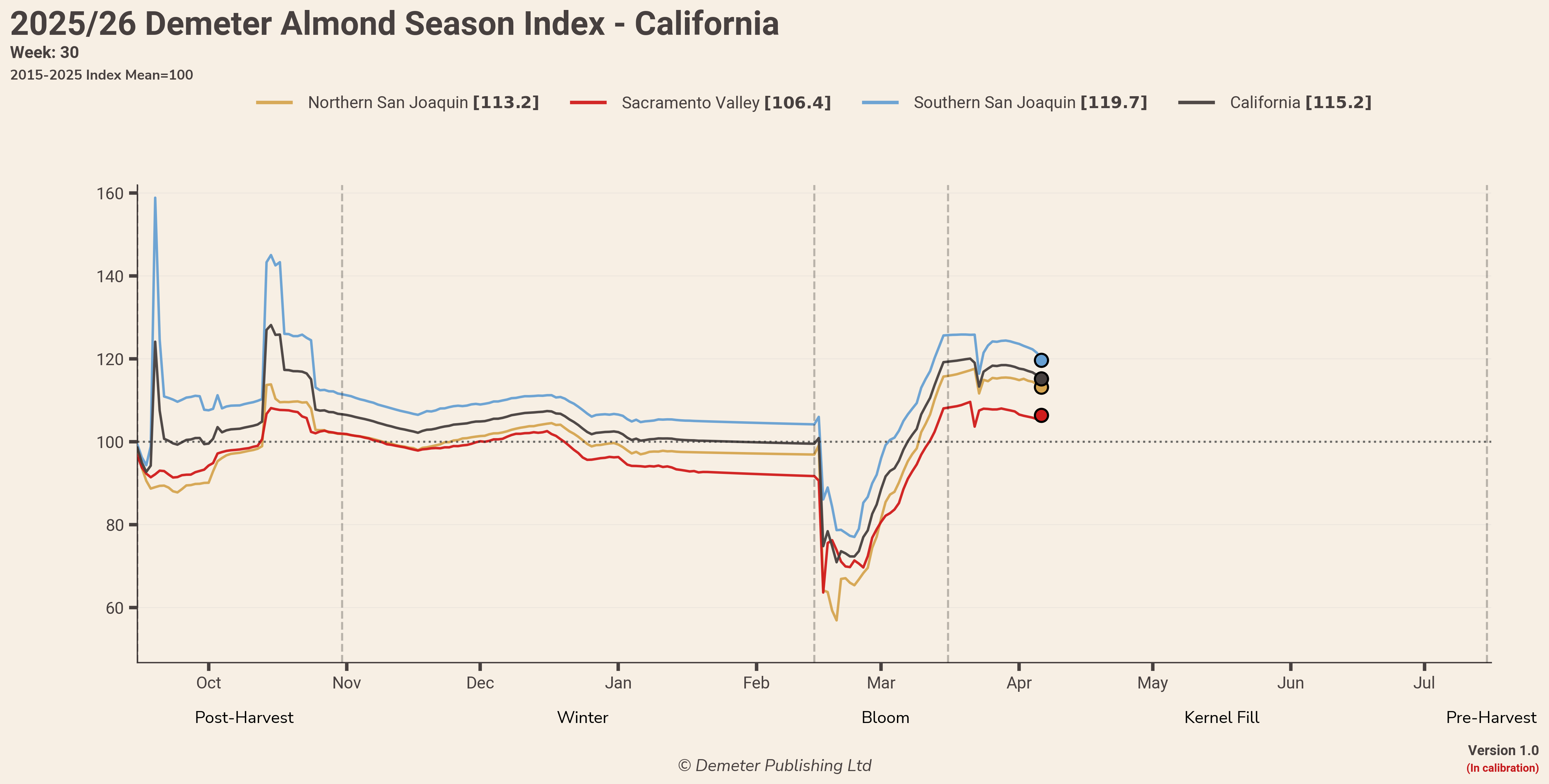
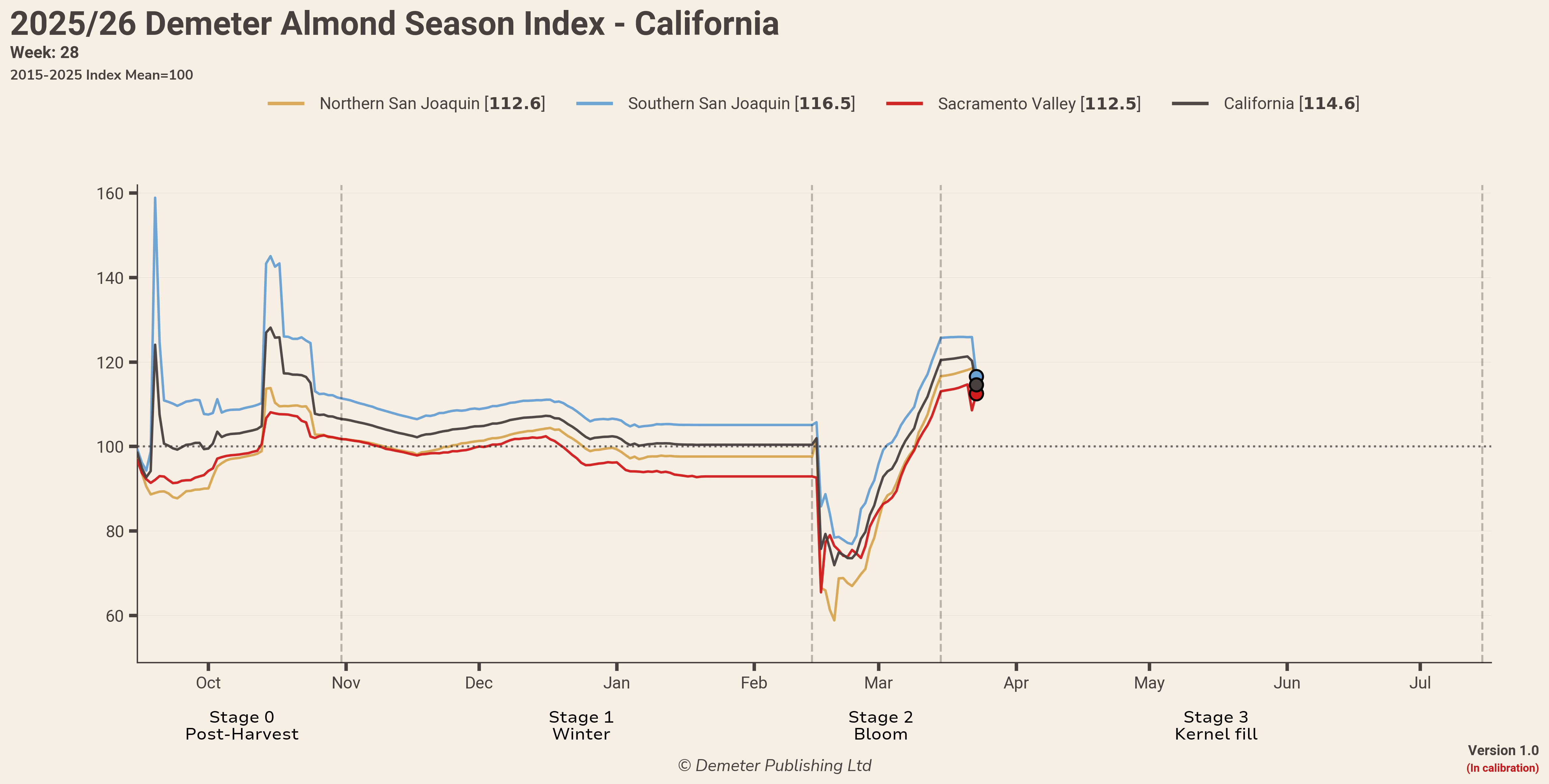
The headline DASI is little changed from prior publication as generally favourable conditions tip into heat stress in some areas.
Browse all published insights and index updates.

The headline DASI is little changed from prior publication as generally favourable conditions tip into heat stress in some areas.

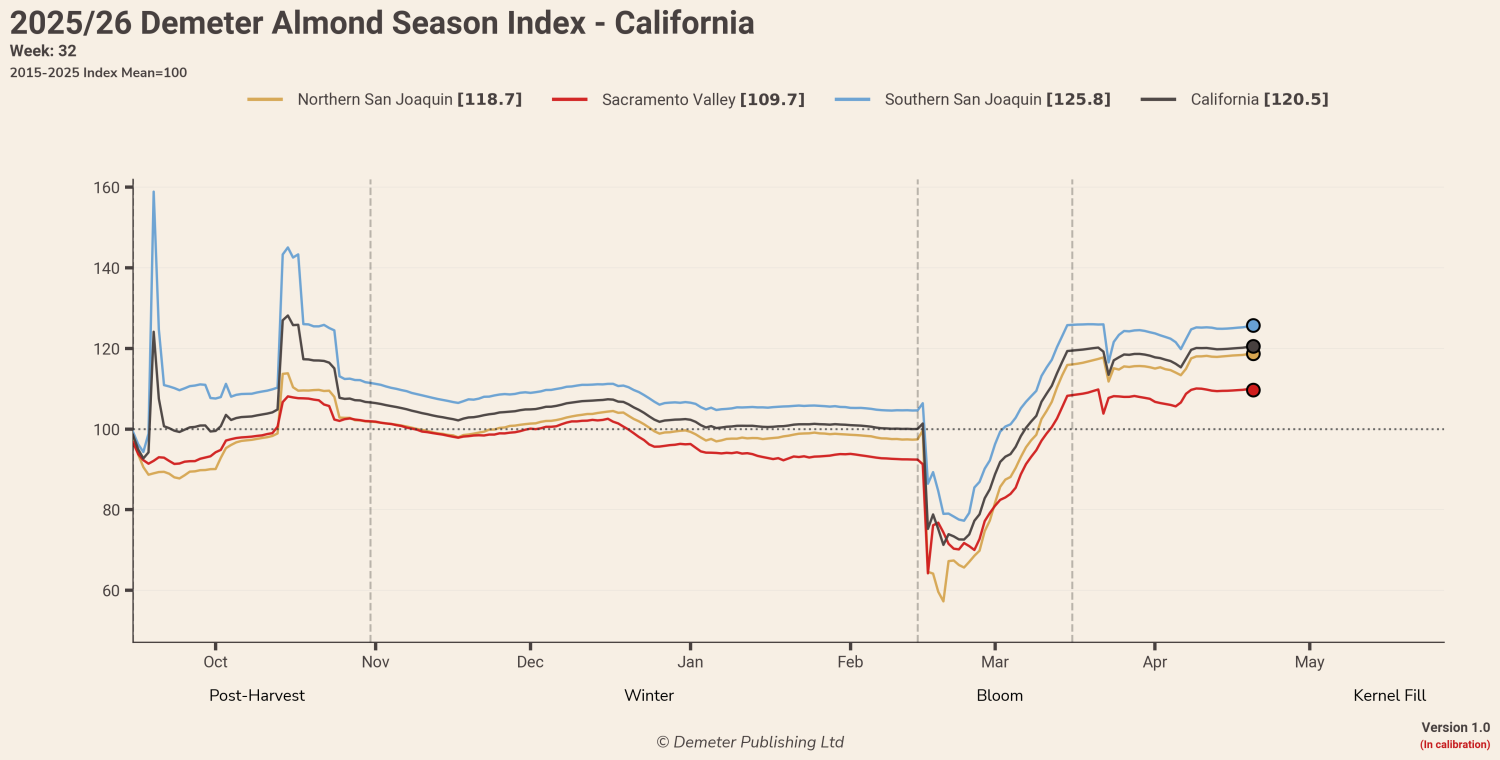
An unusually wet start to the bloom period gave way to highly favourable conditions that reversed February’s decline, leading DASI to its second-highest level in 10 years by the conclusion of bloom.

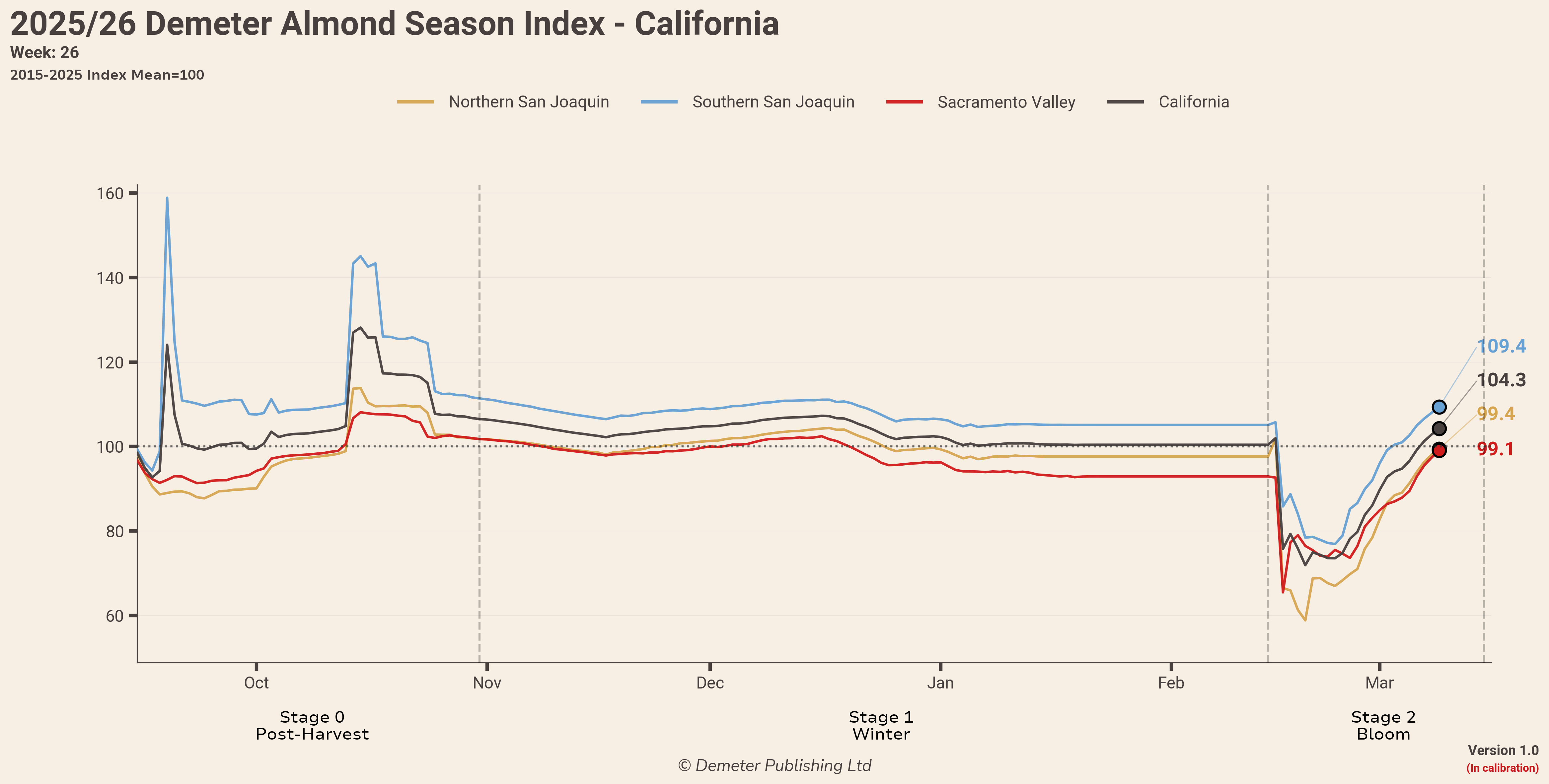
The statewide index continued its strong recovery into the conclusion of the bloom period, led by strong gains in the Sacramento Valley and the northern part of the San Joaquin Valley.

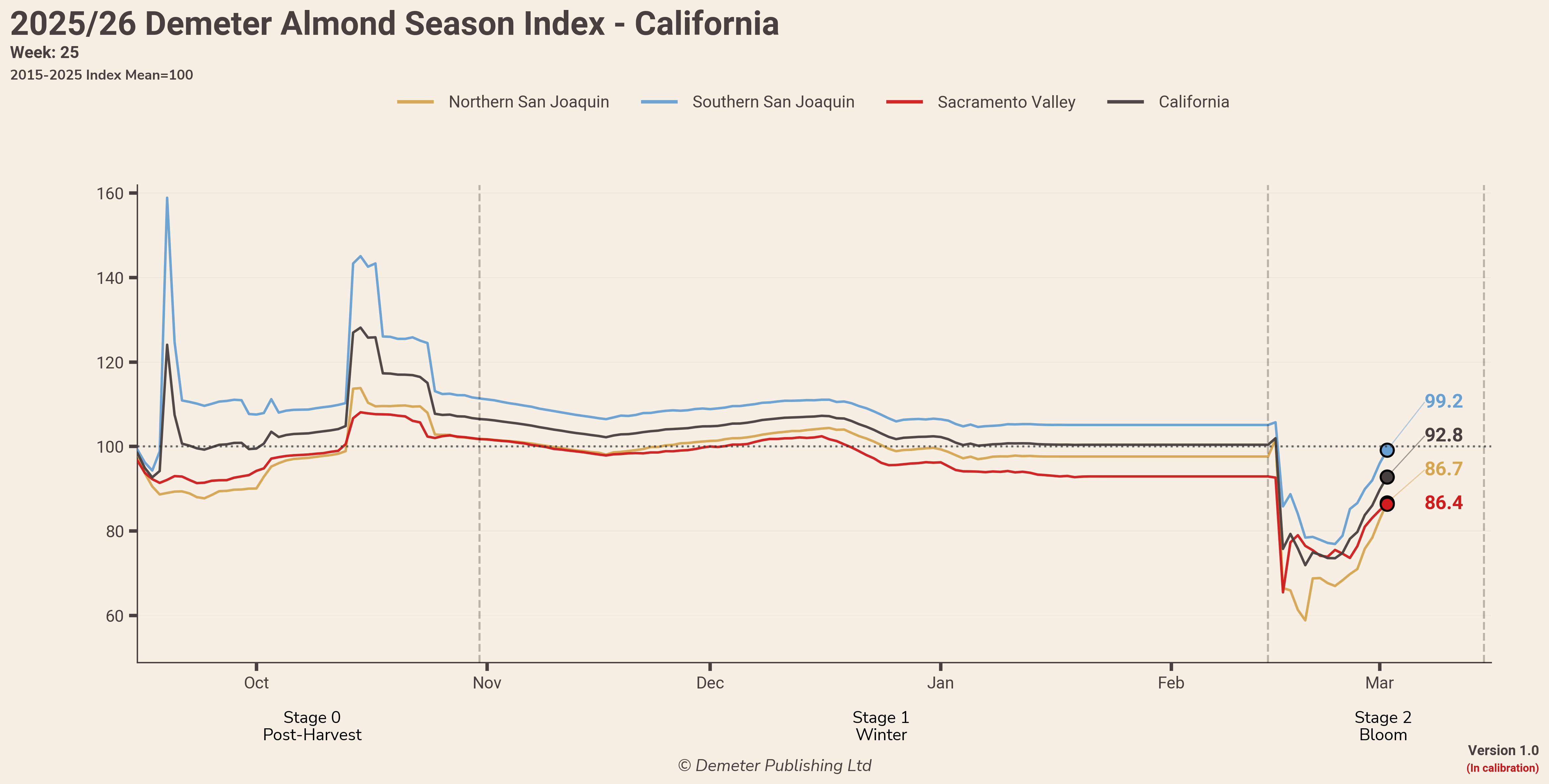
The statewide index recovered substantially over the past week as average temperatures increased across the Central Valley and the abnormal rain events that had weighed on bloom conditions and the index receded.

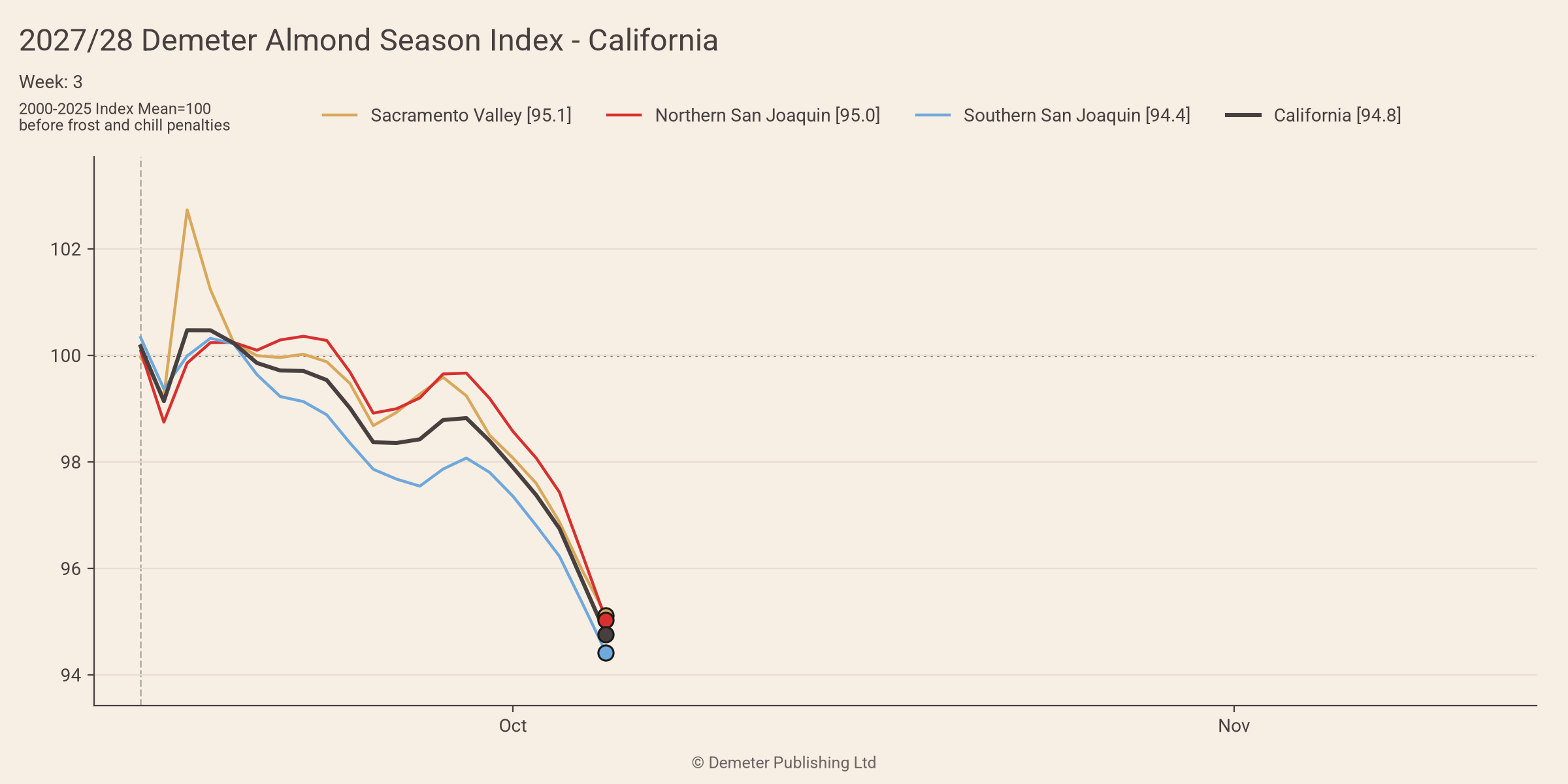
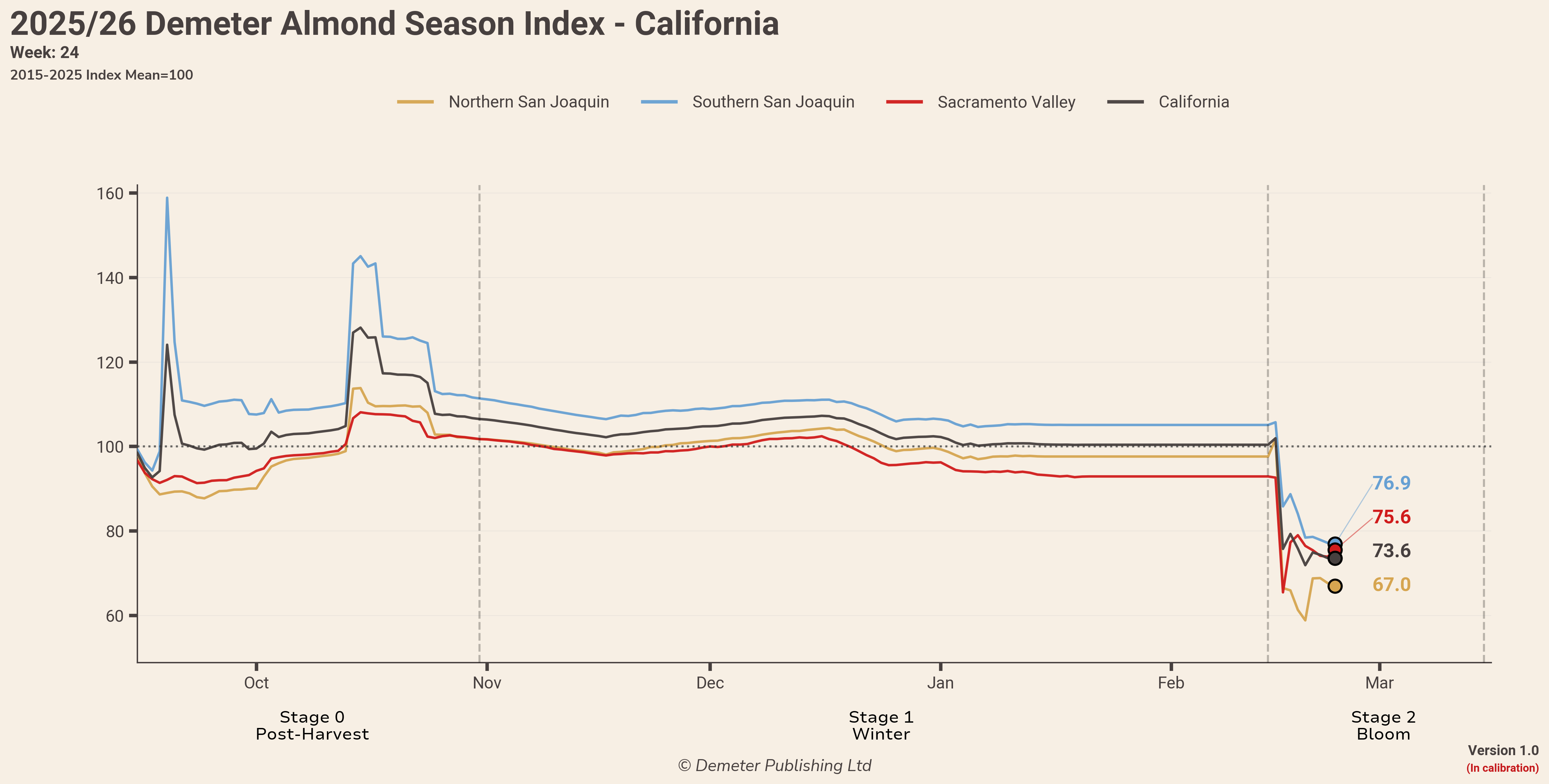
The statewide index was little changed from prior week at 73.6, as a substantially improved index for the Sacramento Valley offset some of the decline from worsening conditions in the Southern San Joaquin Valley.

California's two most important tree nut sectors are diverging at historic scale. This report tracks every acre planted and removed across 40 years by district, basin, and GSA to expose where capital is flowing, where it's retreating, and what it means for supply through the next decade.

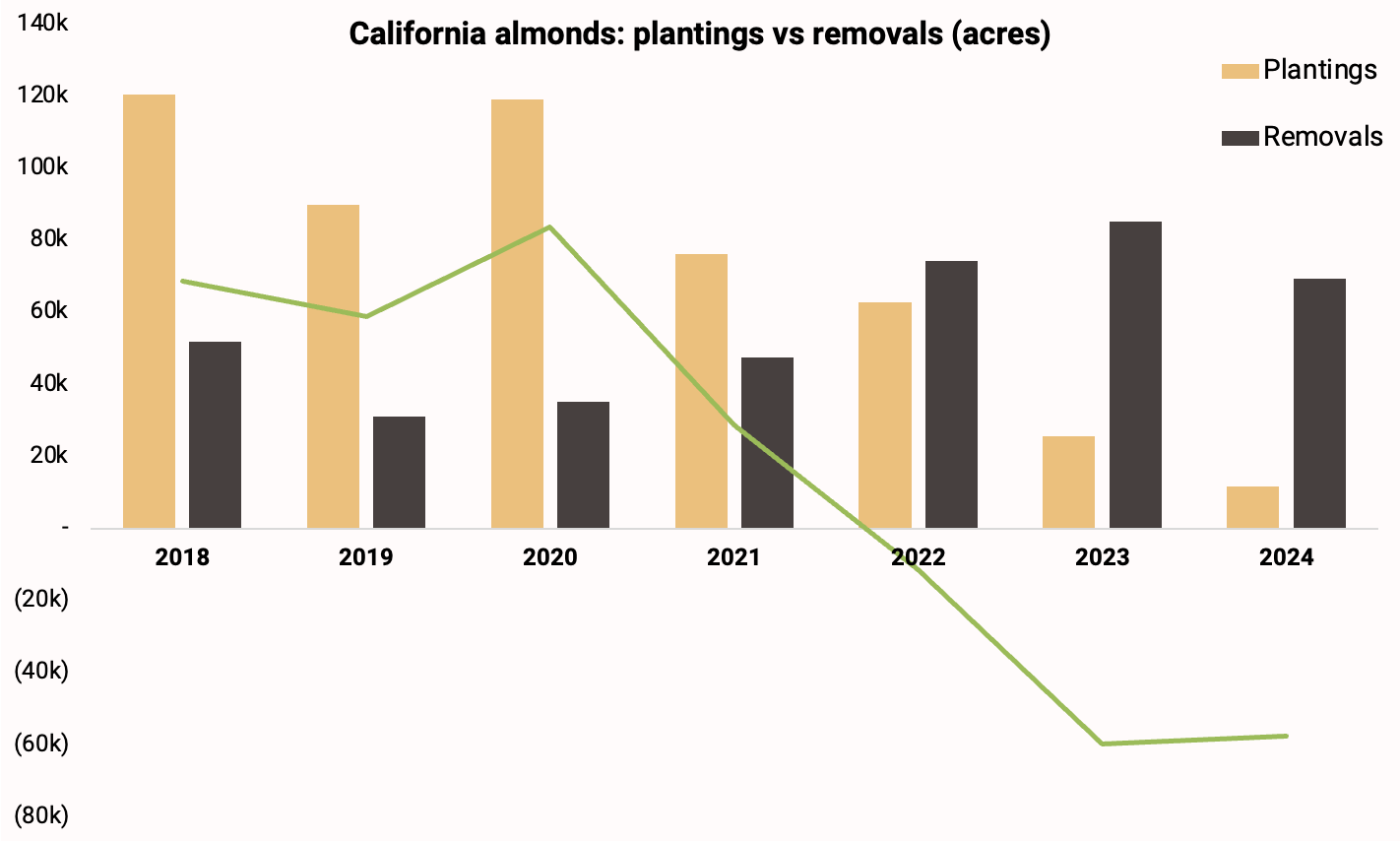
In previous pieces in this series, we documented the scale of California's almond removal wave , which has seen ~450,000 acres (~182k ha) removed between 2014 and 2024, and the shift in planting patterns.

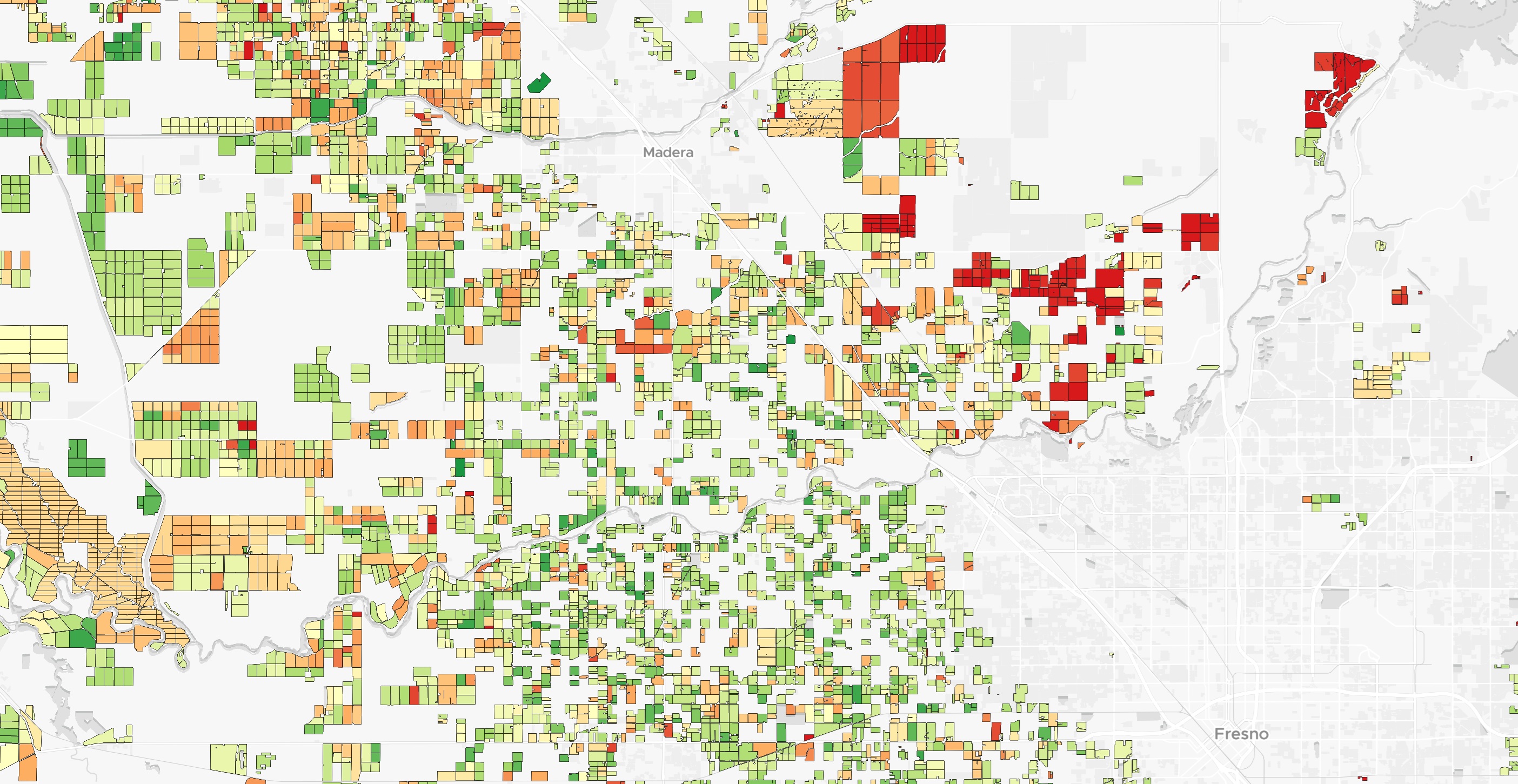
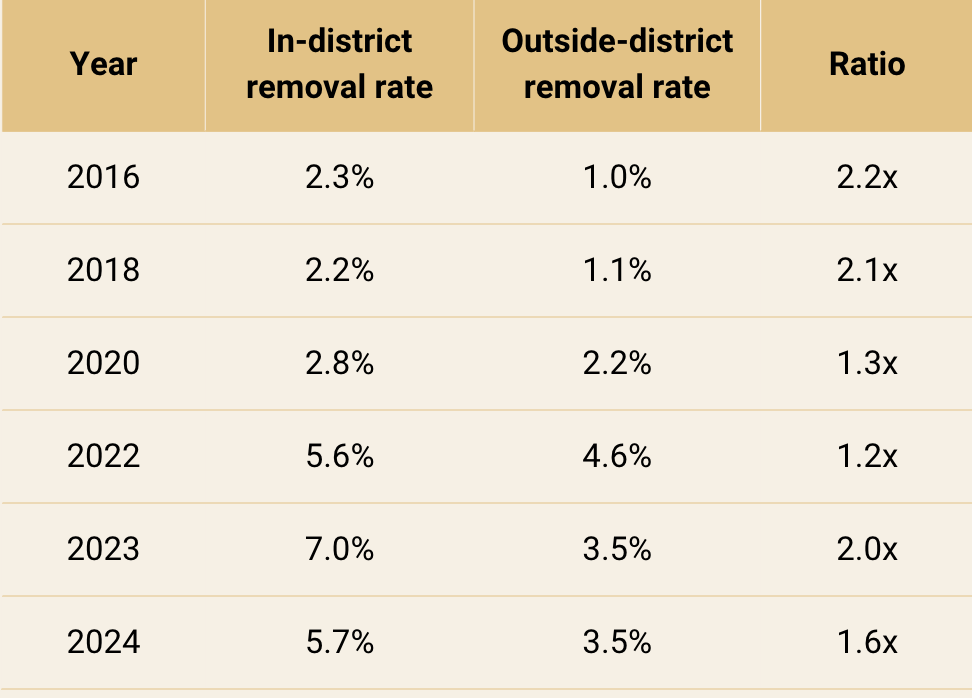
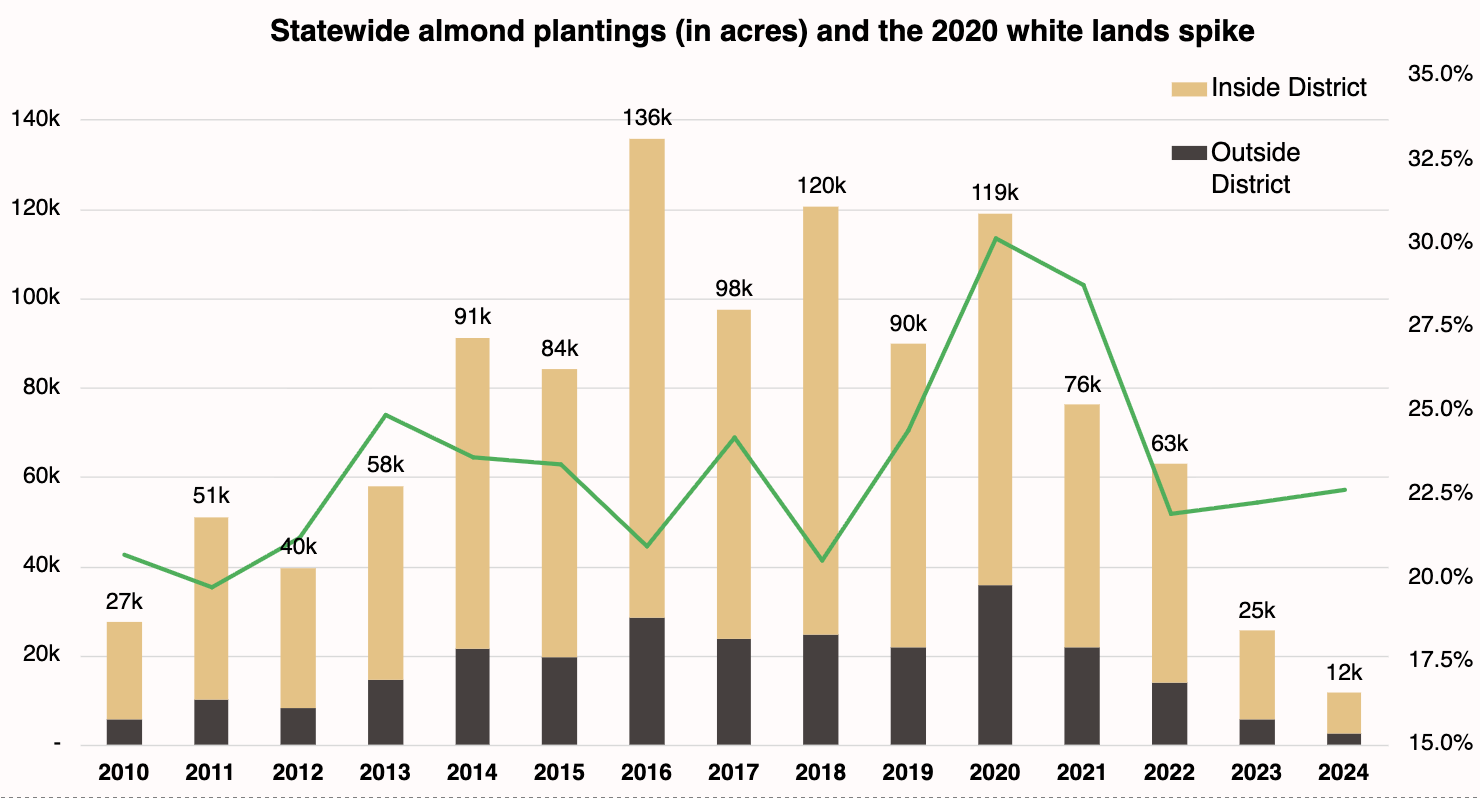
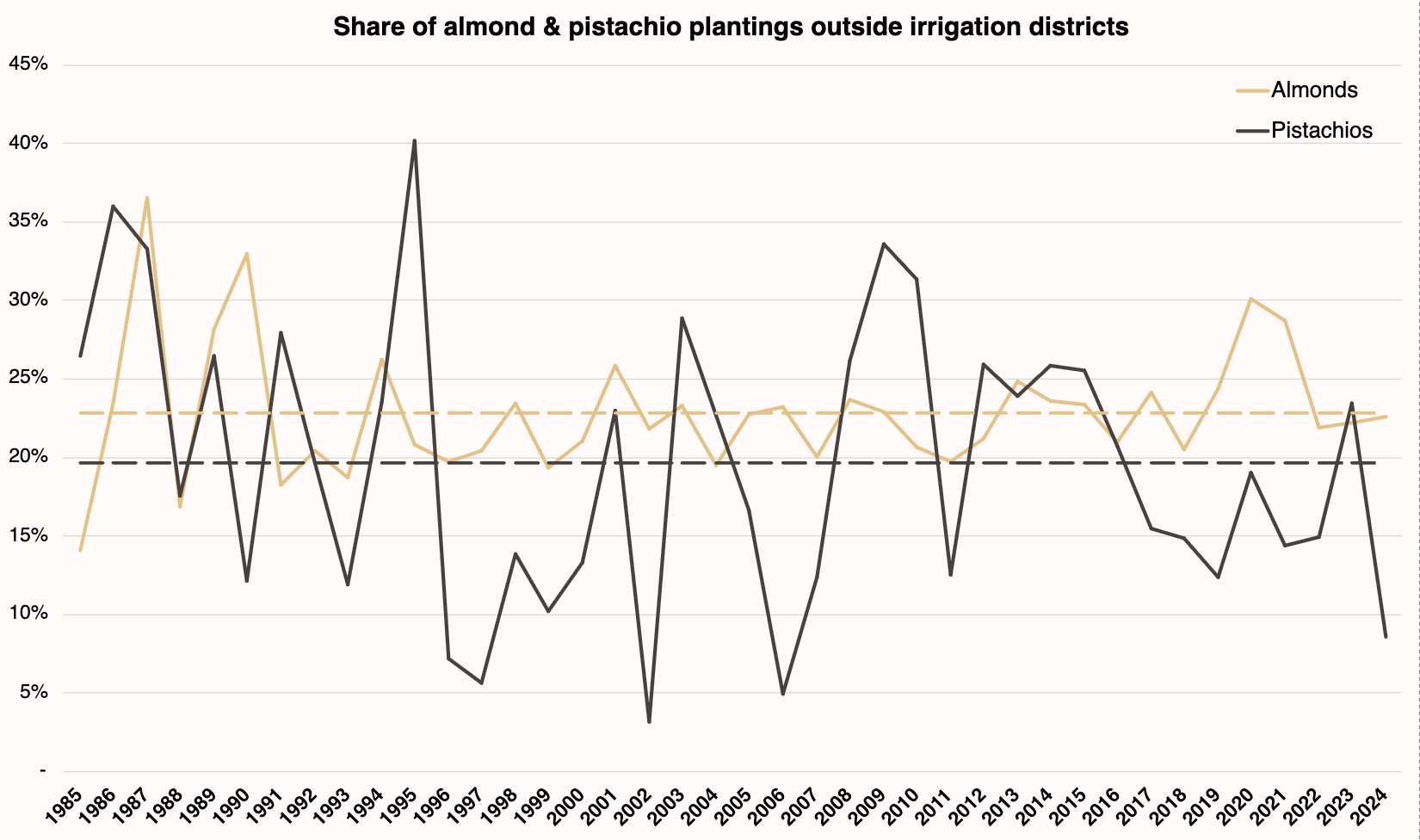
One of the assumptions that runs through most discussions of water risk in Californian permanent crop plantings is that orchards inside irrigation districts - with access to surface water deliveries, in addition to groundwater resources - are better protected than those in white…

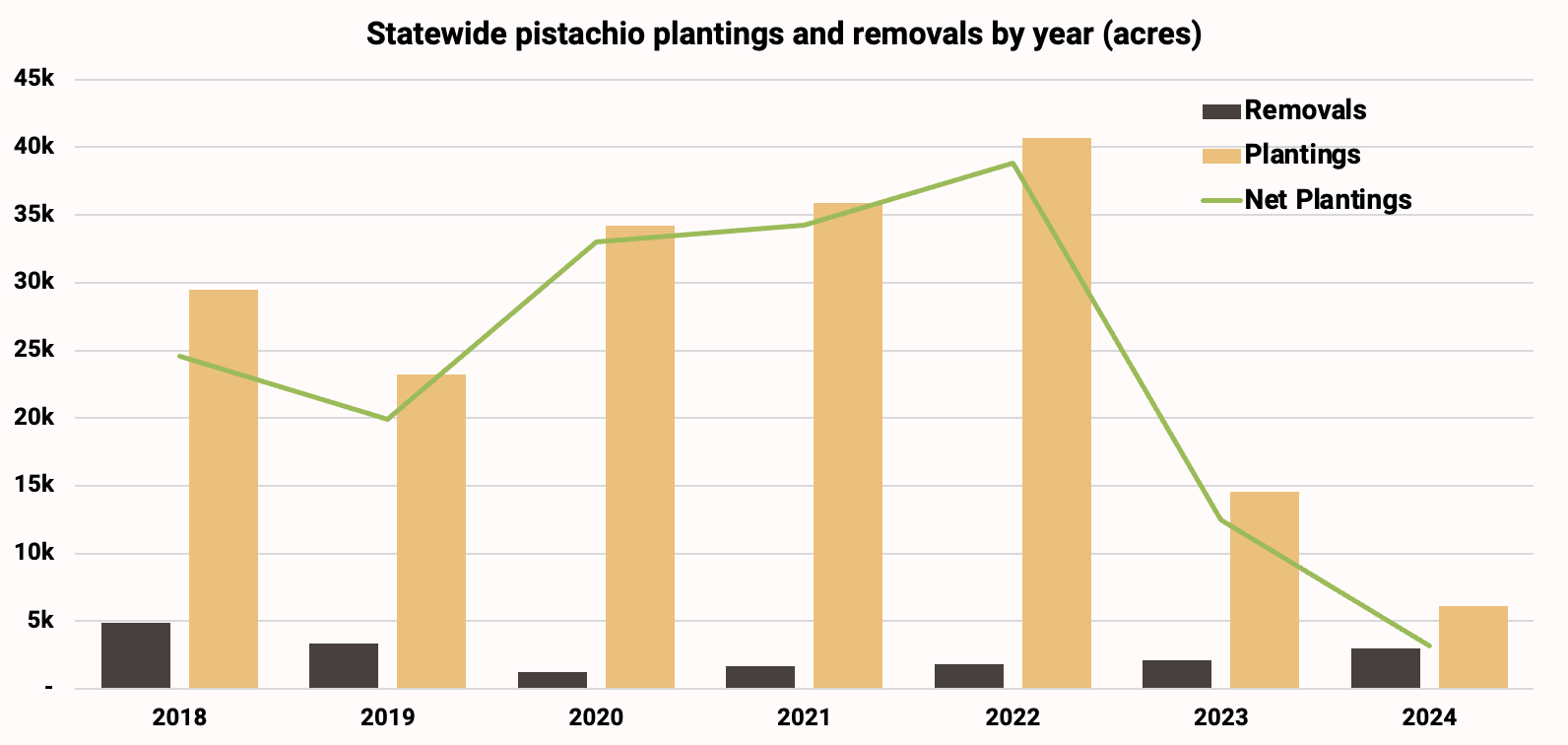
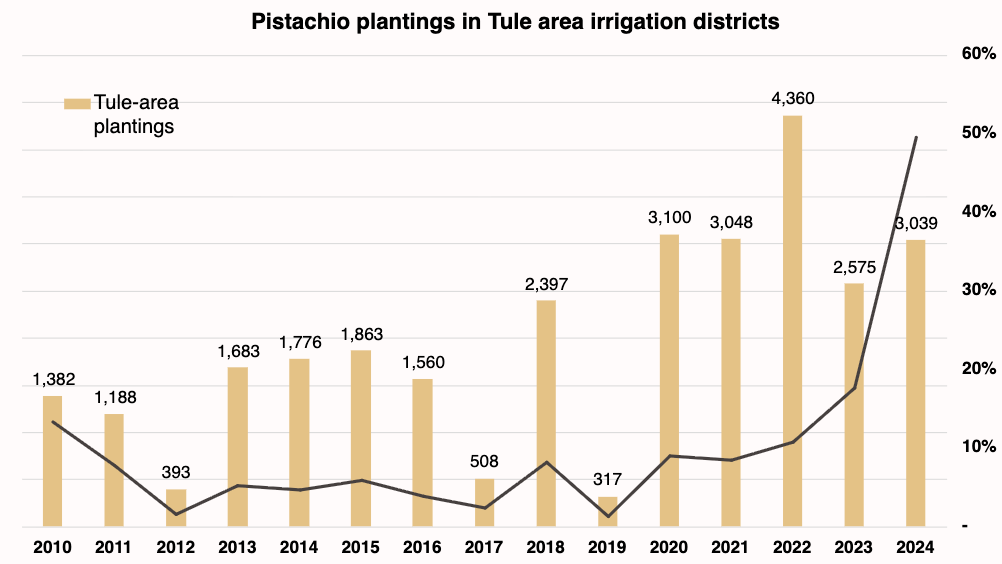
Pistachio removals in California tell a very different story to almonds . The scale is significantly smaller, but with one stand-out finding.

The planting data indicates where new trees are going in. The removals data tells us where existing orchards are coming out. Taken together, they paint a far more complete picture of the trajectory of California's almond supply than either dataset alone.

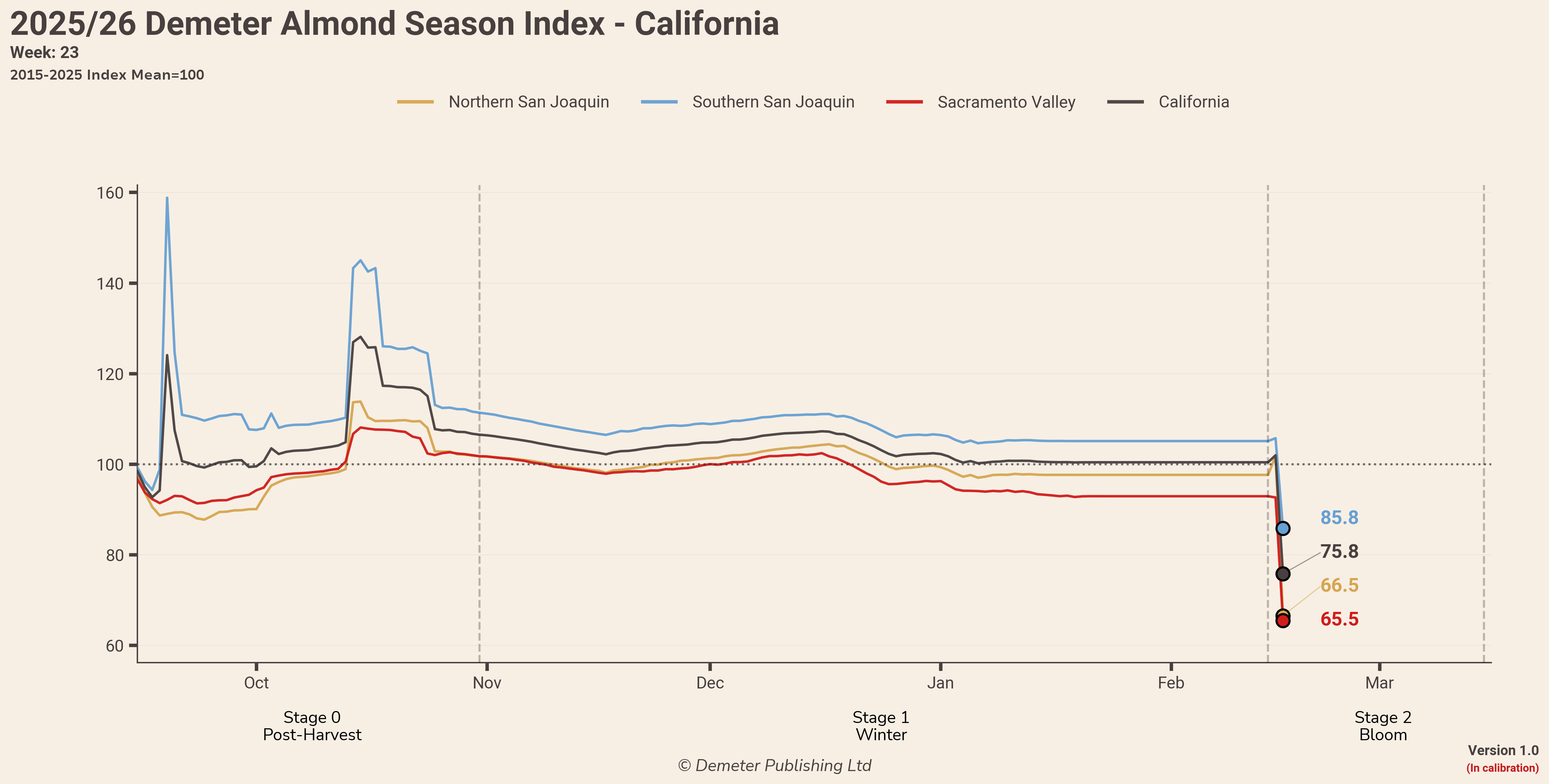
Today's index is 75.8, down 24.5% from 7 days ago. This was driven by extreme precipitation events considerably above long-term averages with 30.1 mm of precipitation across the production footprint. The average temperature was 12.1 C.

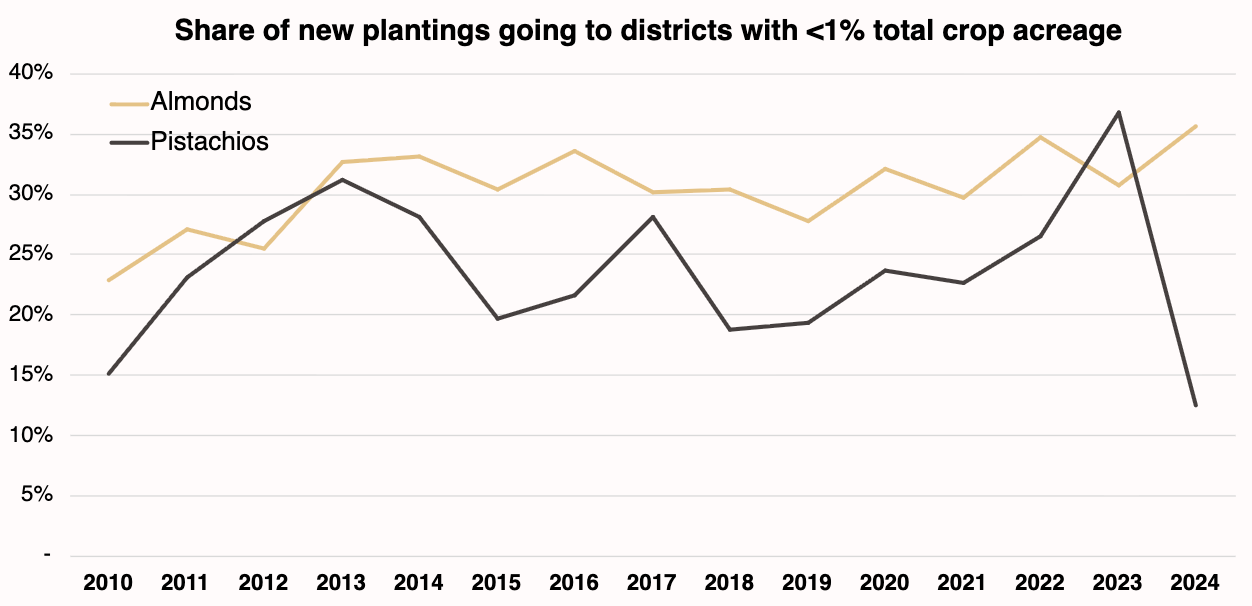
Across this series, we've documented several shifts in where California's almonds and pistachios are being planted: away from Westlands , toward the Tule sub-basin, northward into the Sacramento Valley .

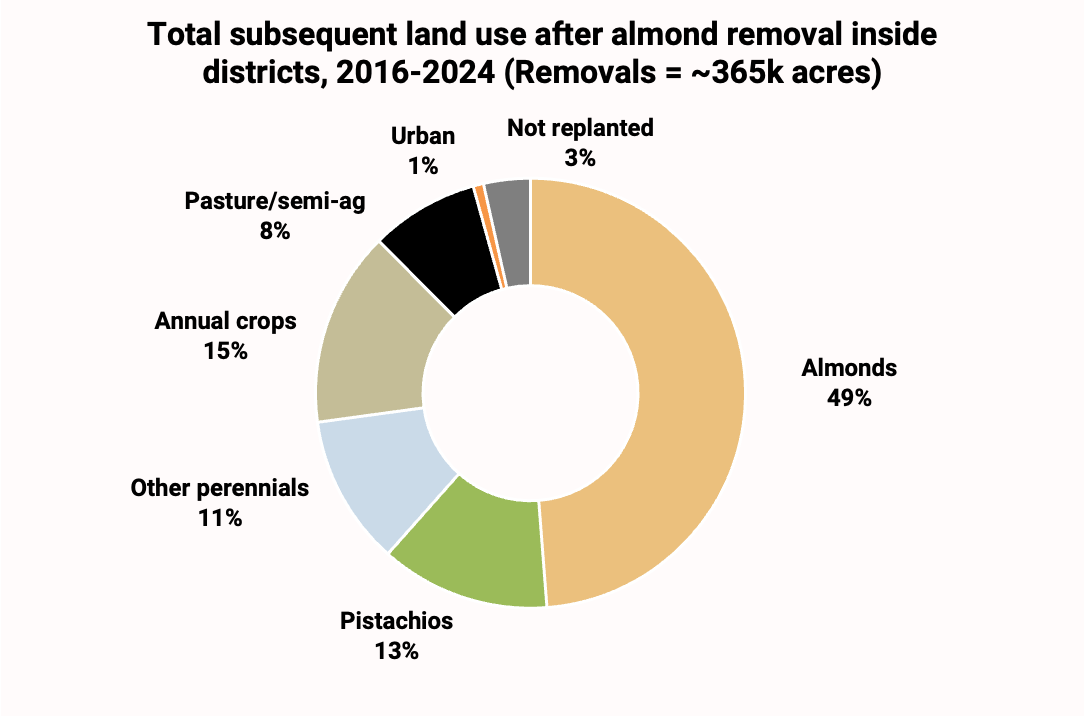
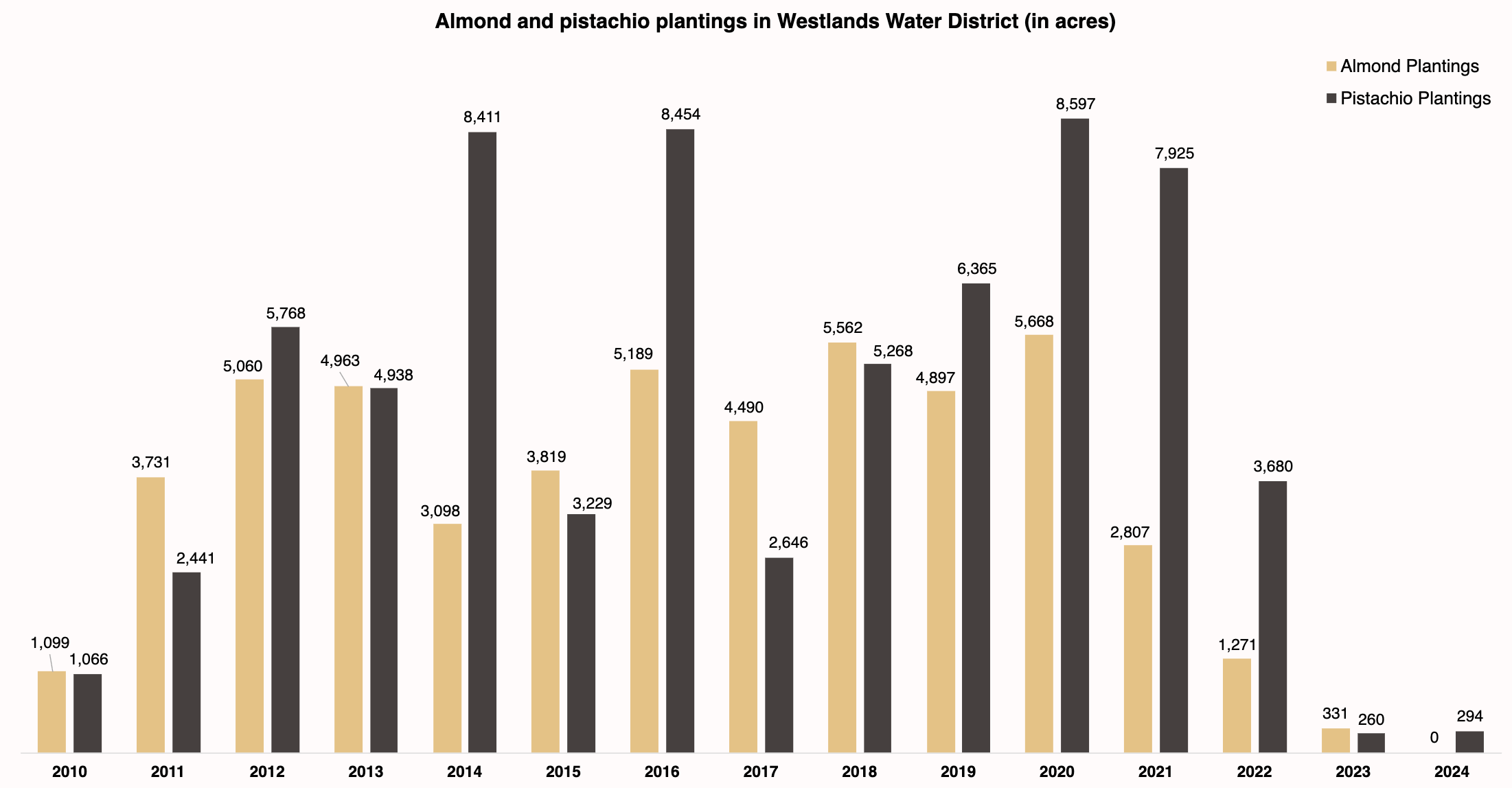
In our previous post , we showed that Westlands Water District - historically the largest single destination for both almond and pistachio plantings - has seen new planting fall dramatically. This raises an obvious question: where has the remaining planting activity gone?

Westlands Water District, on the west side of California's San Joaquin Valley, is the largest agricultural water district in the United States by acreage. For decades, it was one of the most important destinations for new almond and pistachio plantings.

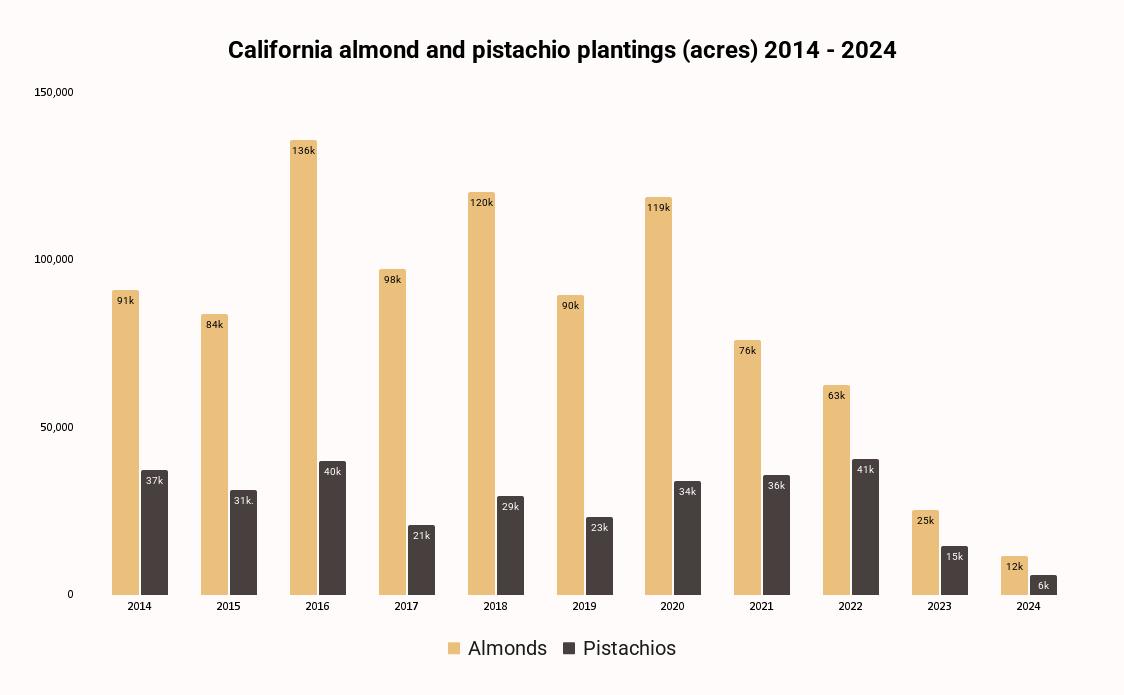
Almonds and pistachios are grown in many of the same regions of California's Central Valley, face the same water constraints, and overlap in their grower base. But their planting trajectories since 2016 have diverged dramatically.
In our previous post , we showed that California almond plantings have collapsed from their 2016 peak. But the decline was not smooth. 2020 stands out as an anomaly.

California's almond and pistachio sectors are planting fewer acres than at any point in the modern era. Demeter has cross-referenced a variety of datasets, including the Department of Water Resources' Land Use Mapping, to track every acre of almonds and pistachios planted and rem…

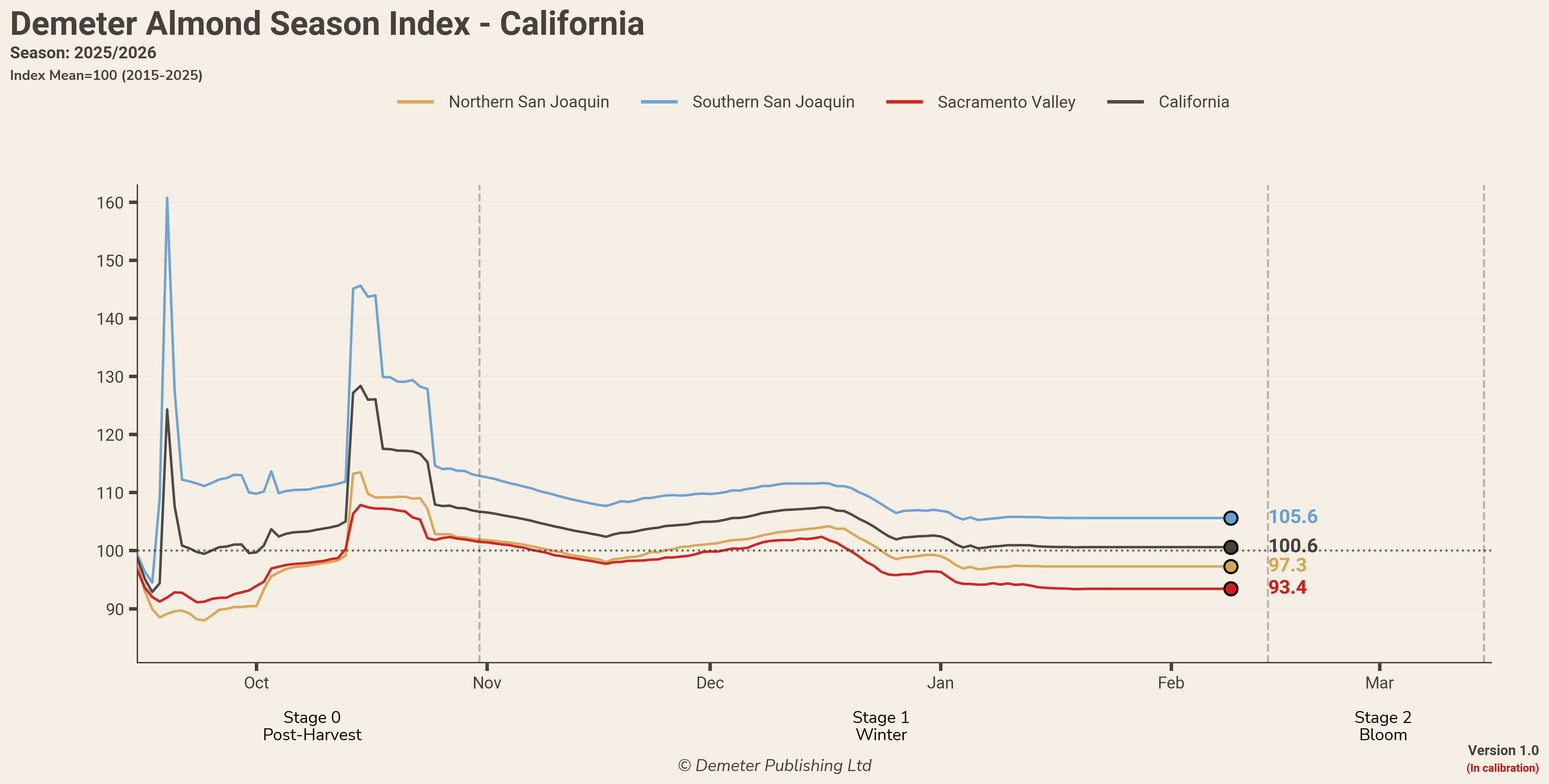
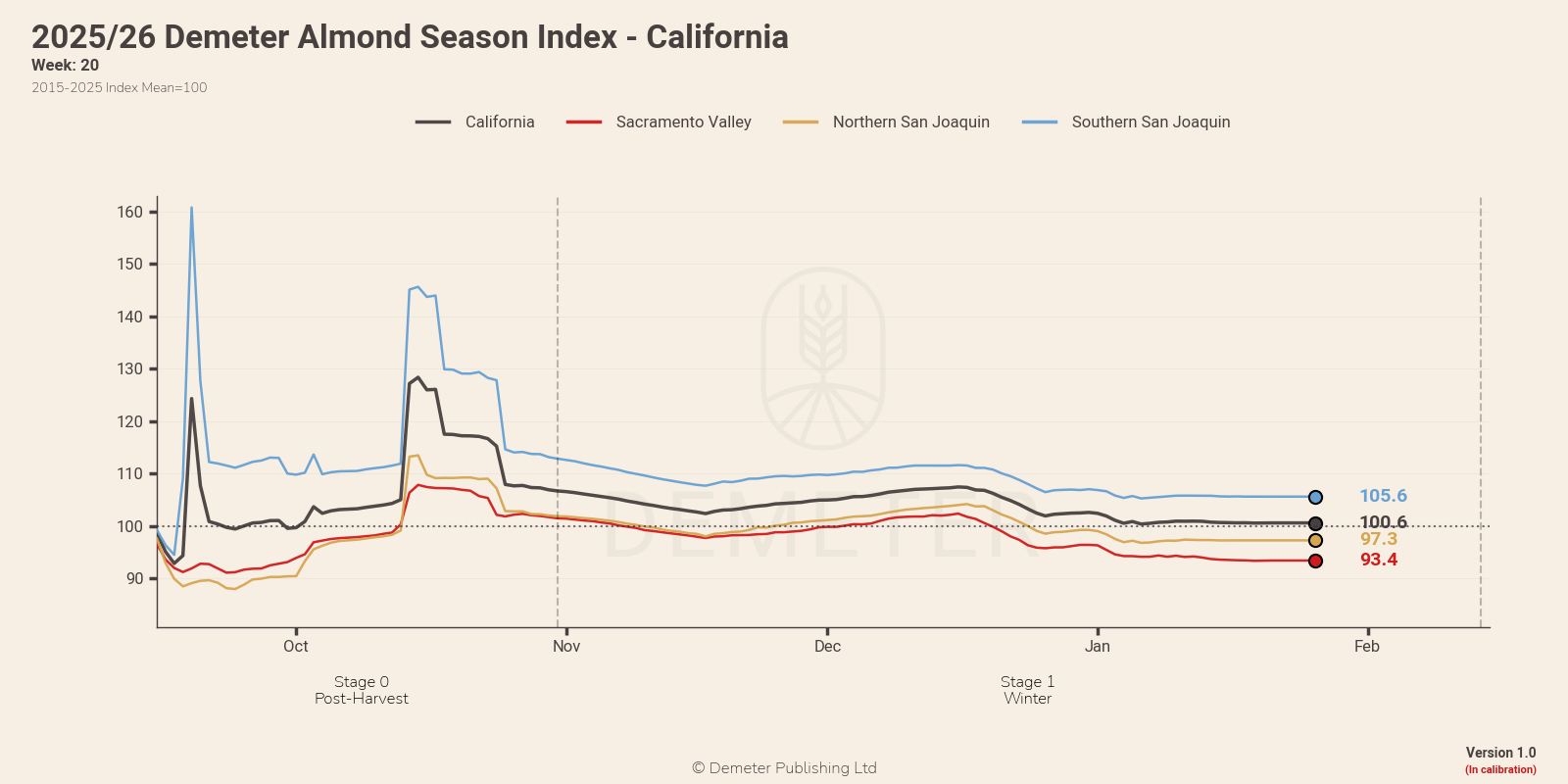
With sufficient winter chill accumulated across California's almond footprint and bloom insufficiently far advanced to move the index, DASI remains unchanged at 100.6.

Movement in the DASI was muted as the remaining areas of California's almond growing footprint reached the sufficient threshold for winter chill accumulation for all almond varieties.

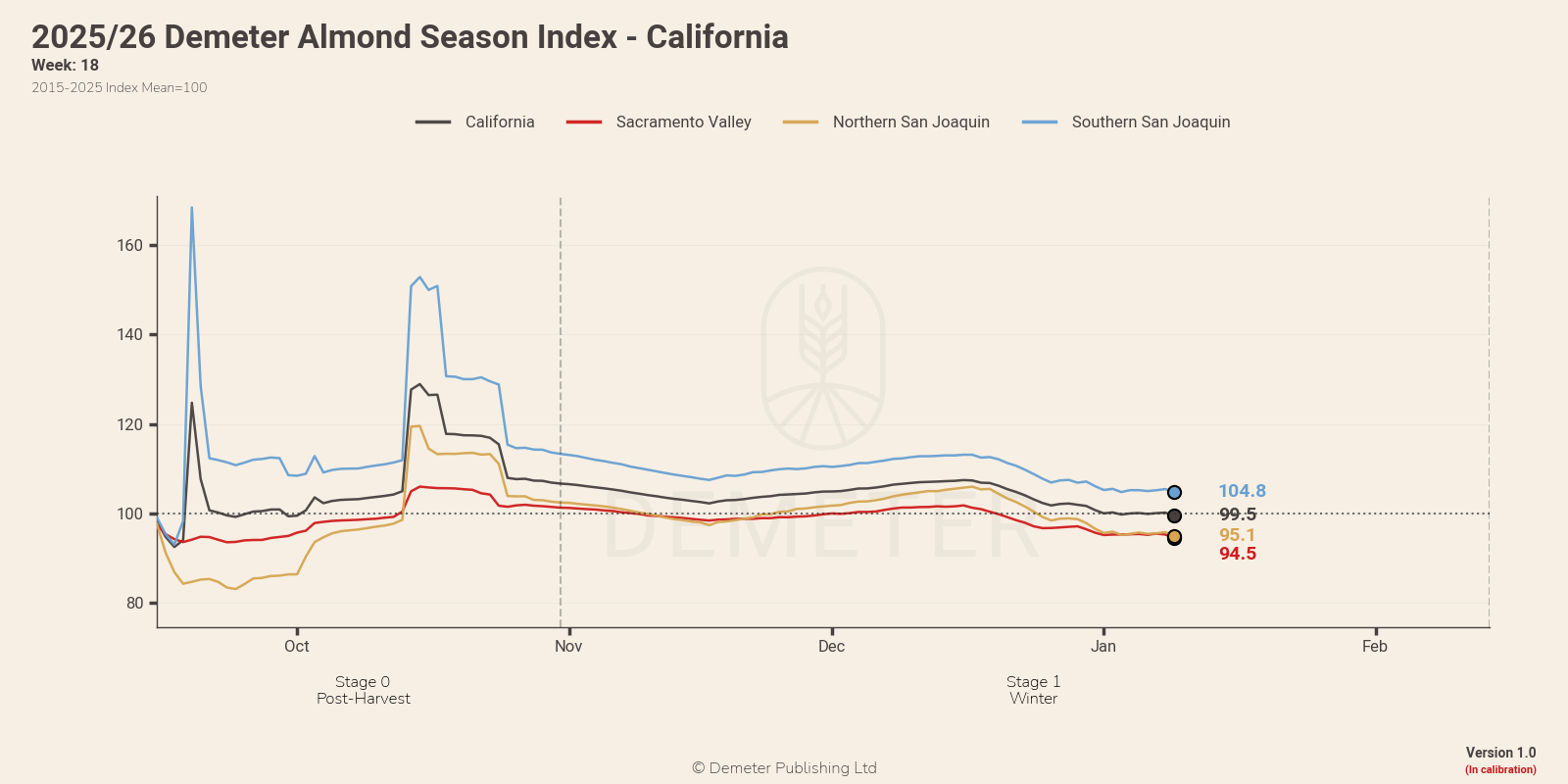
A statewide heavy rain event caused the Sacramento Valley index to rise substantially in mid-October
Humanity measures time by movement. Sundials use the rate of the rotation of the Earth throughout the day. A mechanical watch uses gears that click around at a precise rate.